

Sarosh Kuruvilla is Professor of Industrial Relations, Asian Studies and Public Affairs at Cornell University. Professor Kuruvilla joined Cornell’s faculty in 1990 after obtaining a Doctorate in Business Administration from the University of Iowa in 1989 and after a career as a labor relations manager in the industry in India. He directs the New Conversations Project: Sustainable Labor Standards In Global Supply Chains.

Human Rights in Global Supply ChainsCornell Certificate Program
Human Rights in Global Supply Chains (ILRC08ML)
Enroll Now
Online
Request More Info
More Info
Overview
The device you are using to read this page was created by people in the global workforce. Do you know from which country it originated? Or which international labor agreements, if any, affect the workers who made it? What about the company that sells the product; does it promise fair treatment of those workers?
In this certificate program, you will examine labor practices in the global supply chain and consider how those practices vary and evolve. First, you’ll examine the regulatory framework for global labor relations, including the impact of national treaties on workers. To accomplish this, you’ll explore labor models in your own country as well as other relevant countries, including where your organization does business.
You will then explore industry self-regulation, such as Nike’s Labor Standards, and consider the realities of auditing overseas partners. You’ll also identify the risks of and barriers to transparency along with the ways that reliable data can be made available to consumers and industry partners.
You’ll have six months to complete the required elements for this certificate program, but this flexible approach allows you to finish sooner based on your schedule.
More than likely, the garments you are wearing were manufactured by workers in the Asia-Pacific or Latin American regions — especially if you are wearing “fast fashion.” You might reasonably assume that the worker who sewed your shirt is paid fairly, can take a bathroom break when needed, and is not a child; in other words, a European or American style of labor relations. Yet labor laws vary from one country to the next. This course is designed to give you an overview of global labor relations regulations.
You will analyze the model used in your own country and compare it with a country in which your firm does business. You’ll examine how trade agreements impact workers and explore the influence of regionalized initiatives such as the European Union and the North American Free Trade Agreement (NAFTA).
Many organizations have established a code of conduct — a kind of self-regulation that clarifies how workers will be treated — and these codes often extend to the rest of the supply chain. But how can you ensure that your purchasing team and your suppliers are in compliance?
In this course, you will examine methods for verifying that regulations are followed accurately and consistently. You’ll explore the advantages and disadvantages of auditing as well as how to look for and address violations. Whether you reward suppliers for being in compliance or punish them if they are out of compliance — or both — you’ll consider the difficulties of assessing the supply chain and determine how to make appropriate decisions that support your organization’s code of conduct.
A firm may state goals and values for global labor practices but might not actually meet them in practice; this gap between formal policies and actual practices is known as organizational decoupling. In this course, you will examine ways to overcome decoupling.
You will discover which data can provide accurate measures of policies and practices then identify data sources for your own firm. You’ll understand the responsibilities of and barriers to transparency in multi-stakeholder institutions. Finally, you’ll analyze what is within your locus of control to improve transparency as well as how your organization might be contributing to labor violations.
Request more Info by completing the form below.
more Info
by completing the form below.Act today—courses are filling fast.
How It Works
Time Commitment
40 hours with 6 months of access at your own pace
Cost
$3,750
Engagement
100% self-paced
Power Your Career
Gain today’s most in-demand skills to stand apart.
Flexibility Fits Your Life
Learn on your schedule without stepping out of your job.
Personalized Facilitation
Receive expert feedback and guidance.
Real-world Projects
Apply learning and insights to your work to make an impact right away.
Learn From Top Minds
Courses are developed by Cornell faculty.
Time Commitment
40 hours with 6 months of access at your own pace
Cost
$3,750
Engagement
100% self-paced
Power Your Career
Gain today’s most in-demand skills to stand apart.
Flexibility Fits Your Life
Learn on your schedule without stepping out of your job.
Personalized Facilitation
Receive expert feedback and guidance.
Real-world Projects
Apply learning and insights to your work to make an impact right away.
Learn From Top Minds
Courses are developed by Cornell faculty.
- View slide #1
- View slide #2
- View slide #3
- View slide #4
- View slide #5
- View slide #6
- View slide #7
- View slide #8
- View slide #9
Faculty Authors
Sarosh Kuruvilla
Professor of Industrial Relations, Asian Studies
Cornell ILR School

Jason Judd
Executive Director, Global Labor Institute
Cornell ILR School
Jason Judd is Executive Director of the Cornell ILR Global Labor Institute, which focuses on improving global labor practices. He previously led the Ship to Shore Rights Project at the International Labor Organization in Bangkok and served as Vice President of the Fair Labor Association in Washington, D.C., where he directed all accountability programs, including the FLA’s Fair Compensation work.
Mr. Judd has worked in senior roles for the ILO’s Better Work program, Demos (New York), the Service Employees International Union (SEIU), the AFL-CIO, the Solidarity Center, and the Industrial Areas Foundation. His work has been featured in the New York Times and Financial Times, as well as on PBS. A former Fulbright Fellow, Mr. Judd holds an A.B. in Economics from Duke University and an MPA from l’École Nationale d’Administration (ENA/RULE).
Key Course Takeaways
- Analyze and evaluate labor relations regulatory approaches
- Diagnose issues in your company’s auditing practices and make recommendations for improvement
- Establish best practices for holding your organization accountable
- Evaluate solutions to encourage change in the future and make better decisions for yourself and your organization
- Explore how rigorous analysis of supply chain data and evidence-based decision making can be scaled up to produce better labor practices
- Engage in live discussions with Cornell faculty and peers to deepen your understanding and share experiences

Download Brochure
Fill out the form below to download program information and connect
with us.
Download a Brochure
Not ready to enroll but want to learn more? Download the certificate brochure to review program details.“
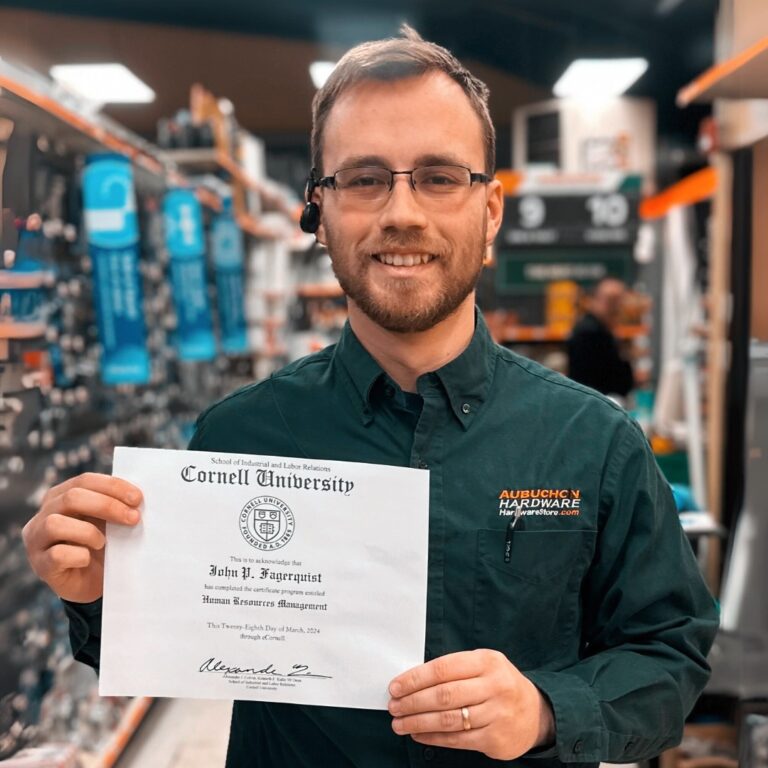
I decided to invest in my future and work toward a career in HR. As a dad of two with a full time job, this online program gave me the chance to work when I could. It was a fantastic way for me to develop my skills and advance my career.
‐ John F.
What You'll Earn
- Human Rights in Global Supply Chains Certificate from Cornell ILR School
- 40 Professional Development Hours (4.0 CEUs)
Watch the Video
Hear eCornell students share their stories.
Who Should Enroll
- Executives in global organizations
- Corporate social responsibility professionals
- Consultants
- Lawyers
- Professionals at NGOs or social auditing firms/investment funds
- Team members from sustainability departments or multi-stakeholder institutions
Frequently Asked Questions
Protecting human rights is critical to the future of global supply chains, and teams are being asked to show credible evidence of what they know, what they are doing, and how they are improving. Cornell’s Human Rights in Global Supply Chains Certificate helps you move from broad commitments to operational decisions by teaching you how to analyze labor practices across countries, understand the regulatory landscape, and make better choices about oversight and accountability.
In this certificate program, authored by faculty from Cornell’s School of Industrial and Labor Relations, you will build practical capabilities you can use immediately, including evaluating regulatory approaches to labor relations, diagnosing weaknesses in audit and monitoring programs, and identifying barriers to transparency so you can make data more reliable for consumers and business partners. You’ll also explore how industry self-regulation works in practice, and what it takes to hold organizations accountable in complex, multi-tier networks.
If you want practical due diligence skills, stronger auditing and transparency decision making, and the ability to translate human rights commitments into supplier action, you should choose Cornell’s Human Rights in Global Supply Chains Certificate.
Many online programs stop at awareness and broad principles. Cornell’s Human Rights in Global Supply Chains Certificate is built to help you make human rights responsibility workable in day-to-day supply chain management through applied analysis, evidence-based decision making, and feedback on your work.
You learn with an expert facilitator who provides feedback on graded, workplace-relevant assignments so you can test how due diligence, auditing, transparency, and accountability choices play out in real sourcing contexts. The Human Rights in Global Supply Chains Certificate curriculum is designed by Cornell ILR School faculty, and the learning experience is structured to help you turn frameworks like the UN Guiding Principles on Business and Human Rights into decisions you can defend internally and externally.
Instead of generic templates, you will work through realistic tensions such as cost, speed, and compliance, and you’ll practice building approaches that go beyond a code of conduct by incorporating monitoring, accountability, and worker-centered mechanisms.
Cornell’s Human Rights in Global Supply Chains Certificate is designed for professionals who influence, assess, or advise on supply chain practices and need a clearer, more operational approach to human rights risk. The program is a strong fit if you work in or alongside global sourcing, procurement, compliance, sustainability, legal, or corporate responsibility functions and you want to strengthen how your organization identifies, prevents, and remediates labor and human rights issues.
The Human Rights in Global Supply Chains Certificate program is also well suited if you support organizations as an external advisor, including as a consultant, lawyer, NGO professional, social auditing professional, or team member at an investment fund or multi-stakeholder institution. Executives in global organizations often enroll when they need a practical way to evaluate governance approaches and improve accountability across complex supplier networks.
Project work in Cornell’s Human Rights in Global Supply Chains Certificate is designed to help you convert concepts into concrete policies, practices, and decision tools you can take back to your organization.
Past learners have completed projects such as:
- Building a phased transparency roadmap that defines priority stakeholders, specifies where to publish supplier and audit data, and sets KPIs for audits, grievances, and worker voice while managing greenwashing and disclosure risks
- Diagnosing barriers to credible labor-rights accreditation by pinpointing gaps in tiered supply chain mapping, weak purchasing data controls, and missing purchase-order discipline that can undermine evidence quality
- Proposing a purchasing-to-compliance alignment plan that strengthens vendor due diligence documentation, tracks public-facing compliance KPIs, and requires suppliers to sign the code of conduct to support stronger audit outcomes
- Analyzing a complex agricultural labor audit approach and showing why layered methods, including worker interviews, expert input, and document reviews, improve credibility beyond policy-only checks
- Evaluating trade agreements as labor governance tools by comparing weak versus enforceable mechanisms and explaining how facility-level enforcement can shift supplier behavior over time
Across these deliverables, you practice the same kinds of analysis and recommendations that stakeholders increasingly expect from supply chain, compliance, and sustainability teams.
Cornell’s Human Rights in Global Supply Chains Certificate helps you build credible, job-ready capability to identify, assess, and strengthen how human rights responsibilities are managed across global supply chains.
After completing the Human Rights in Global Supply Chains Certificate, you will be prepared to:
- Analyze and evaluate labor relations regulatory approaches
- Diagnose issues in your company’s auditing practices and make recommendations for improvement
- Establish best practices for holding your organization accountable
- Evaluate solutions to encourage change in the future and make better decisions for yourself and your organization
- Explore how rigorous analysis of supply chain data and evidence-based decision making can be scaled up to produce better labor practices
- Engage in live discussions with Cornell faculty and peers to deepen your understanding and share experiences
Learners commonly report finishing Cornell’s Human Rights in Global Supply Chains Certificate program with a more operational understanding of what human rights responsibility looks like in day-to-day supply chain management, along with practical tools they can apply immediately.
Cornell’s Human Rights in Global Supply Chains Certificate is delivered through our Mentored Learning format and consists of 3 courses requiring approximately 12 to 14 hours of study for each, or 40 hours of coursework in total. You have up to 6 months to complete all necessary components, though you may finish in fewer than 6 months depending on your schedule. The program allows you to follow an individualized structured learning agenda with a flexible approach that includes interaction and project feedback with your expert facilitator. You'll also complete graded projects that let you apply learning concepts to on-the-job situations.
Throughout the Human Rights in Global Supply Chains Certificate program, your expert facilitator provides personalized feedback on all projects and offers opportunities for 1:1 mentoring sessions as you progress. This guided approach allows you to ask questions and receive support as you work through practical applications and real-world scenarios.
In Cornell’s Human Rights in Global Supply Chains Certificate, learners consistently look for practical ways to identify, prevent, and remediate human rights risks across complex, multi-tier supply networks, and the program is built to deliver exactly those capabilities.
Students typically emphasize outcomes like:
- Applying the UN Guiding Principles on Business and Human Rights to real supply chain decisions
- Conducting human rights due diligence, from risk mapping through remediation planning
- Addressing modern slavery and forced labor risks with clearer indicators and escalation paths
- Designing supplier expectations that go beyond a code of conduct, including monitoring and accountability
- Building worker centered grievance mechanisms and integrating worker voice into oversight
- Translating human rights commitments into procurement and sourcing leverage with suppliers
- Using case based analysis to navigate common tensions, such as cost, speed, and compliance
- Communicating human rights performance to internal stakeholders and external reporting needs
Overall, learners describe leaving with a sharper, more operational understanding of how human rights responsibilities show up in day-to-day supply chain management, plus tools they can immediately apply to policies, supplier engagement, and risk management practices in their organizations.
Human rights due diligence can feel abstract until you have to decide what to prioritize, what evidence is credible, and how to respond when risks surface. Cornell’s Human Rights in Global Supply Chains Certificate equips you to structure due diligence as a repeatable set of decisions, from understanding the regulatory context to evaluating what monitoring and remediation can realistically achieve in different countries and sectors.
You will practice identifying where transparency breaks down, what makes audits more or less reliable, and how to scale evidence-based analysis of supply chain data so you can make stronger recommendations. Cornell’s Human Rights in Global Supply Chains Certificate program also reinforces how to connect human rights expectations to procurement and supplier engagement, so commitments translate into action rather than remaining a policy statement.
Modern slavery and forced labor risks often hide in subcontracting, recruitment practices, and weak oversight across tiers. Cornell’s Human Rights in Global Supply Chains Certificate helps you move beyond vague screening by developing clearer ways to identify risk indicators, evaluate the limits of audits, and design escalation and remediation paths that fit real supplier relationships.
You will explore how governance mechanisms, including national approaches and trade agreements, can shape labor practices over time. You should finish Cornell’s Human Rights in Global Supply Chains Certificate program better prepared to set supplier expectations that go beyond a code of conduct and to support accountability through stronger monitoring, transparency, and worker-centered mechanisms.
Transparency and reporting can create value only when the underlying evidence is credible and the disclosures are thoughtfully designed. Cornell’s Human Rights in Global Supply Chains Certificate helps you assess where audit and supplier data can be reliable, where it can be misleading, and how to improve the systems that support credible claims.
You will work through practical considerations such as diagnosing weaknesses in auditing practices, identifying barriers to transparency, and using supply chain data more rigorously to support decision making. Project work throughout Cornell’s Human Rights in Global Supply Chains Certificate commonly includes building a transparency roadmap with KPIs and disclosure choices while explicitly managing greenwashing and disclosure risk as well as aligning purchasing discipline with compliance documentation so the evidence behind reporting holds up under scrutiny.
Explore Related Programs


















Request Information Now by completing the form below.
Act today—courses are filling fast.
Purchase Options
3750

$3,750
Human Rights in Global Supply Chains
| Select Payment Method | Cost |
|---|---|
| $3,750 |
Review Program Pricing and Details