
Complex decisions begin with asking the right questions. In this course, you will explore the concepts and tools used to frame complex decisions affected by uncertainty, competing objectives, and multiple stakeholders. You’ll define the key components of a decision problem, identify the values and objectives that guide decision making, and apply a decision analysis framework to a complex real-world problem. You’ll also examine how your perspective can influence the way problems are framed and solutions are evaluated.

In this course, you will learn how decision trees can help organize complex decisions and evaluate alternative courses of action. You’ll construct decision trees, map possible outcomes, calculate risk profiles, and assess how performance measures influence decision paths. You’ll also explore the strengths and limitations of decision trees to determine when they are — and when they are not — the appropriate tool for decision analysis.

Even the most quantitative decisions involve subjective judgment. In this course, you will examine how biases, heuristics, expert judgment, and uncertainty influence decision making. You’ll explore methods for incorporating subjective information into quantitative analyses, evaluate the value of additional information, and assess how risk and uncertainty impact the quality of your decisions.

In this course, you will examine how risk attitudes and utility theory influence decision making when outcomes involve uncertainty and competing priorities. You’ll explore key concepts, including utility functions, axioms, and paradoxes, and learn how to incorporate subjective preferences into quantitative decision models. Finally, you’ll apply these concepts within a decision tree framework to evaluate more realistic and complex decision scenarios.

Many real-world decisions involve thousands of possible alternatives and competing objectives. In this course, you will learn how simulation-based optimization helps identify effective solutions to complex design and engineering problems. You’ll formulate multi-objective decision models, evaluate trade-offs using concepts such as Pareto optimality and non-dominance, and explore advanced approaches for supporting complex decision making.

In this course, you will examine how uncertainty affects system performance and decision outcomes. You’ll use Monte Carlo simulation to evaluate the risks, sensitivities, and trade-offs associated with different design alternatives while exploring decision making under deep uncertainty. By considering a range of plausible future scenarios, you’ll learn how to develop solutions that perform reliably under changing conditions.

In this course, you will apply the concepts and tools developed throughout the program to model complex decisions under uncertainty. Using the open-source Python library Rhodium, you’ll analyze multiple problem formulations, evaluate trade-offs among competing objectives, and identify robust solutions across a range of uncertain future conditions. You’ll conclude the course by applying these techniques to a comprehensive simulation-based decision analysis project.

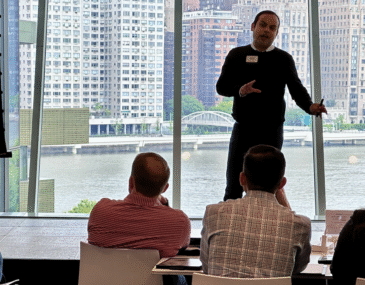
eCornell online Workshops are live, interactive 3-hour learning experiences led by Cornell faculty experts. These premium short-format sessions focus on AI topics and are designed for busy professionals who want to gain immediately applicable skills and strategic perspectives. Workshops include faculty presentations, breakout discussions, guided hands-on practice, and downloadable resources.

The AI Workshops All-Access Pass provides you with unlimited participation for 6 months from your date of purchase. Whether you choose to attend one workshop per month or several per week, the All-Access Pass will allow you to customize your AI journey and stay on top of the latest AI trends.

Hosted by Cornell faculty at the forefront of their fields, Workshops cover a range of cutting-edge AI topics applicable across industries. Whether you are just getting started with AI, seeking to build your AI skillset, or exploring advanced applications of AI, Workshops will provide you with an action-oriented learning experience for immediate application in your career. Sample Workshops include:

  • Work Smarter With AI Agents: Individual and Team Effectiveness
  • Leading AI Transformation: Bigger Than You Imagine, Harder Than You Expect
  • Using AI at Work: Practical Choices and Better Results
  • Search and Discoverability in the Era of AI
  • Don’t Just Prompt AI – Govern It
  • AI-Powered Product Manager
  • Leverage AI and Human Connection To Lead Through Uncertainty

Request
more Info
by completing the form below.

Act today—courses are filling fast.

How It Works

Managing engineers is tough, but leading them is even tougher. As an electrical engineer with management aspirations, I wanted to become a true leader who could build and maintain strong relationships with my department. A year after completing this engineering program, I was promoted to Engineering Manager and was able to hit the ground running.
‐ Bobby W.
Bobby W.
  • Engineers responsible for evaluating complex systems, designs, and technical trade-offs
  • Operations research, systems engineering, and product development professionals seeking more rigorous decision-making methods
  • Data scientists, data analysts, and quantitative professionals who support complex planning and decision making
  • Technical leaders and managers responsible for evaluating risk, balancing competing objectives, and making high-impact decisions