
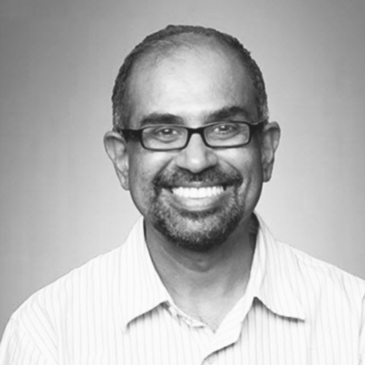
Rajesh Bhaskaran’s work seeks to promote the “democratization of simulation” through effective integration of simulation tools into engineering education. He directs the Swanson Lab and has helped introduce industry-standard simulation tools into Cornell courses covering fluid mechanics, heat transfer, solid mechanics, and numerical analysis. Dr. Bhaskaran has led the development of SimCafe.org as an online portal for learning and teaching finite-element and CFD simulations. SimCafe is used worldwide in courses as well as for self-paced learning by students and industry professionals. Dr. Bhaskaran has developed a unified methodology for using simulation in disparate lecture-based and lab courses. This methodology teaches students to approach simulations like an expert rather than just pushing buttons and accepting results at face value. Dr. Bhaskaran’s professional interests include engineering applications of simulation technology, reliable deployment of advanced simulation by generalist engineers, and conceptual change in learners using simulations. He has organized two international workshops on simulation in engineering curricula.

Finite Element AnalysisCornell Certificate Program
Request More Info
Overview and Courses
When challenges arise in design, it is crucial for engineers and their teams to have the right awareness and skill set to solve complex problems like an expert. Using finite element analysis (FEA), you can predict how a part or assembly will behave under given conditions, setting you up to innovate computationally.
In this certificate program, you will build your conceptual understanding of finite element-based simulations. As you do, you will gain hands-on experience, from solving simple structural problems using Ansys Mechanical to solving practical problems that involve elasticity and plasticity with realistic geometries and loads. You will also solve applied problems using methods such as beam and shell analysis as well as modal and random vibration analysis. By the end of this certificate program, you will have the foundational skills to build reliable and valid FEA simulations for practical problem solving in your career ahead.
You’ll be most successful in this program if you have a basic knowledge of differential and integral calculus and Newton’s second law as well as some prior exposure to statics.
We strongly recommend you use a desktop version of Ansys. If you don’t already have access to Ansys, be sure your machine meets the following hardware requirements to download and use the free student desktop version of Ansys:
- Supported platforms and operating systems: Microsoft Windows 10, 64-bit
- Minimum hardware requirements: Workstation class processor, 4 GB RAM, 25 GB hard drive space, Computer must have a physical C:/” drive present, professional workstation class 3-D graphics card and driver, OpenGL capable.
If your machine does not meet these requirements, you may also use an online version of Ansys. Be sure you meet the following bandwidth requirements: 5Mbps download speed and 100 ms maximum roundtrip latency.
You will have six months to complete the required elements for this certificate program, but this flexible approach allows you to finish sooner based on your schedule.
Finite element analysis (FEA) is a computational technique used to predict how a part or assembly behaves under given conditions, thus reducing the need for physical prototypes in product design while enabling the exploration of a large number of potential designs. It can be used, for example, to simulate the buckling of a wind turbine blade, the deformation of a pressure vessel, or the vibrational response of an electronics enclosure; these are all problems that can be solved computationally that would otherwise be impossible to do by hand.
FEA also helps you generate clear visual representations of your solution that make interpretation by humans much easier and enable us to develop physical intuition. To ensure that your solutions accurately represent reality, however, you first need to understand how the “black box” of your modeling software functions and have methods to verify and validate your results.
In this course, you will investigate the major elements of what is inside the black box to gain a deep conceptual understanding of how FEA software produces solutions. This will help you build an intuitive understanding of the fundamental mathematical models and physics underlying simulations of the static and dynamic behavior of engineering structures.
You will also familiarize yourself with the numerical solution strategy employed to solve the mathematical models using the finite element method as well as how to minimize errors. Ultimately, this course will prepare you to build reliable and valid FEA simulations for practical problems using industry-standard simulation software such as Ansys.
Professor Bhaskaran’s framework for solving finite element problems can be applied to an array of situations and contexts. In this course, you will have the opportunity to practice applying this framework and begin creating simulations using Ansys.
This course has been designed with a focus on problem-based learning. Guided by faculty video, you will work on a “bar in extension” problem in Ansys then practice solving a challenge problem on your own. To get the most out of the experience, you should work through each phase of the problem and reach out to your facilitator when you are stuck.
Once you have completed the “bar in extension” problem, you will be ready to take on a new but similar challenge: bar under gravity force. This challenge problem will require you to apply the same concepts and techniques that you practiced in the example problem but without videos to guide you. You’ll be required to answer graded questions at each stage of the process.
Your final simulation will be a product of your efforts and give you the confidence to begin working on more complex problems in finite element analysis.
Professor Bhaskaran’s framework for solving finite element problems can be applied to an array of situations and contexts. To practice applying this framework and create simulations using Ansys, your effort in this course will be focused on problem-based learning.
You will explore the big ideas in 3D elasticity then apply them to solve an example static structural problem in Ansys. The example problem will involve analyzing a pressure vessel with a realistic geometry and loads. The geometry will be provided to you as a CAD file.
As we set up and solve the simulation in Ansys, we will keep returning to the big ideas to make sense of the Ansys inputs and outputs. You will follow along in Ansys and study best practices for simulating static structural applications.
Your final simulation will be a product of your efforts and give you the confidence to create reliable static structural simulations.
Professor Bhaskaran’s framework for solving finite element problems can be applied to an array of situations and contexts. To practice applying this framework and create simulations using Ansys, your effort in this course will be focused on problem-based learning.
You will examine the big ideas in beam and shell theories which form the basis for many practical static and dynamic simulations. Shell theory details are complex, but we can understand the underlying concepts as an extension of beam theory. You’ll apply the big ideas in shell theory to solve a practical problem in Ansys; namely, a wind turbine blade with realistic geometry and loads.
You will walk through solving the wind turbine blade example problem in Ansys. The geometry will be provided to you as a CAD file. As you set up and solve the simulation in Ansys, you’ll continue to refer back to the big ideas to make sense of the Ansys inputs and outputs. You’ll also consider best practices for simulating practical shell problems.
Your final simulation will be a product of your efforts and give you the confidence to create reliable beam and shell simulations.
Vibration is an important consideration in many engineering applications, including compressors, turbines, gears, and bearings. Modal analysis is used to predict the natural frequencies of the structure. Knowing these frequencies, the engineer can design the structure to avoid resonance leading to catastrophic failure.
In this course, you will explore the big ideas in modal analysis by extending 3D elasticity concepts then apply those big ideas to solve a practical problem in Ansys: predicting the natural frequencies and mode shapes for a turbine disk with blades.
You will walk through solving the “turbine disk with blades” example problem in Ansys. The geometry will be provided to you as a CAD file. As you set up and solve this vibration simulation in Ansys, you’ll continue to refer back to the big ideas in modal analysis to make sense of the Ansys inputs and outputs. You’ll follow along in Ansys and consider best practices for simulating vibration problems.
Your final simulation will be a product of your efforts and give you the confidence to create reliable vibration simulations.
eCornell online Workshops are live, interactive learning experiences lasting 1 to 4 hours and led by Cornell faculty experts. These premium, short-format sessions focus on AI topics and are designed for busy professionals who want to gain immediately applicable skills and strategic perspectives. Workshops may include faculty presentations, breakout discussions, and guided hands-on practice.
The AI Workshops All-Access Pass provides you with unlimited participation for 6 months from your date of purchase. Whether you choose to attend one Workshop per month or several per week, the All-Access Pass allows you to customize your AI journey and stay on top of the latest AI trends.
Hosted by Cornell faculty at the forefront of their fields, Workshops cover a range of cutting-edge AI topics applicable across industries. Workshops are offered at three levels to allow you to choose topics that match your experience.
- AI Foundations
- These Workshops introduce core AI concepts, terminology, capabilities, limitations, and practical applications. No prior AI experience is required.
- Best for: Beginners, AI-curious professionals, and teams starting their AI journey.
- AI in Practice
- These Workshops focus on practical skills, workflows, and strategies that help participants use AI more effectively in their day-to-day work. Some familiarity with AI tools is recommended.
- Best for: Professionals who have experimented with AI and want to build confidence and capability.
- AI Leadership and Transformation
- These advanced Workshops explore emerging technologies, strategic implementation, governance, organizational impact, and specialized applications. AI fluency is expected, and some Workshops may have prerequisites.
- Best for: AI leaders, transformation teams, executives, and advanced practitioners.
Request more Info by completing the form below.
How It Works
Faculty Author
Key Course Takeaways
- Build your conceptual understanding of finite element-based simulations
- Solve a simple structural problem using Ansys Mechanical
- Solve practical problems that involve elasticity and plasticity with realistic geometries and loads
- Solve practical problems such as wind turbine blade buckling using beam and shell analysis
- Solve practical vibration problems (turbine blade and disk, beam, aviation electronics) using modal and random vibration analysis
Download a Brochure
Not ready to enroll but want to learn more? Download the certificate brochure to review program details.
What You'll Earn
- Finite Element Analysis Certificate from Cornell Duffield College of Engineering and Sibley School of Mechanical and Aerospace Engineering
- 70 Professional Development Hours (7 CEUs)
Watch the Video
Who Should Enroll
- Engineers and technical professionals using simulation tools for product design and analysis
- Mechanical, aerospace, manufacturing, and industrial engineers working with structural or vibration problems
- Professionals seeking hands-on experience with finite element analysis (FEA) and Ansys Mechanical
- Engineers looking to build reliable simulation and validation skills without deep mathematical specialization
- Technical professionals interested in applying FEA to real-world engineering challenges and product development
Explore Related Programs













Explore programs to meet your professional goals

- 2 to 6 months
- $2,000 to $10,000
- Online

- 2 to 4 weeks
- $299 to $1,199
- Online

- 3 hours
- $449
- Online

- 15 to 24 months part-time
- Tuition varies
- In person or online
- 2 to 5 days
- $3,000 to $10,000
- In person - Ithaca or NYC
- Custom Enterprise Programs
- Price varies
- In person or hybrid
Request Information Now by completing the form below.

$3,900
Finite Element Analysis
| Select Payment Method | Cost |
|---|---|
| $3,900 |