


Kilian Weinberger is an Associate Professor in the Department of Computer Science at Cornell University. He received his Ph.D. from the University of Pennsylvania in Machine Learning under the supervision of Lawrence Saul and his undergraduate degree in Mathematics and Computer Science from the University of Oxford. During his career he has won several best paper awards at ICML (2004), CVPR (2004, 2017), AISTATS (2005) and KDD (2014, runner-up award). In 2011 he was awarded the Outstanding AAAI Senior Program Chair Award and in 2012 he received an NSF CAREER award. He was elected co-Program Chair for ICML 2016 and for AAAI 2018. In 2016 he was the recipient of the Daniel M Lazar ’29 Excellence in Teaching Award. Kilian Weinberger’s research focuses on Machine Learning and its applications. In particular, he focuses on learning under resource constraints, metric learning, machine learned web-search ranking, computer vision and deep learning. Before joining Cornell University, he was an Associate Professor at Washington University in St. Louis and before that he worked as a research scientist at Yahoo! Research in Santa Clara.
Request More Info
Overview and Courses
Machine learning is emerging as today’s fastest-growing career as the role of automation and AI expands in every industry and function.
Cornell’s Machine Learning certificate program equips you to implement machine learning algorithms using Python. You will use a combination of math and intuition to practice framing machine learning problems and construct a mental model to understand how data scientists approach these problems programmatically. Through investigation and implementation of k-Nearest Neighbors, naive Bayes, regression trees, and others, you’ll explore a variety of machine learning algorithms and practice selecting the best model, considering key principles of how to implement those models effectively. You’ll also gain the skills to work with advanced generative models, including transformers, to create and refine both text and image outputs. In addition, you’ll have an opportunity to implement algorithms on live data while practicing debugging and improving models through approaches such as ensemble methods and support vector machines. Finally, the coursework will explore the inner workings of neural networks and how to construct and adapt neural networks for various types of data.
This program uses Python and the NumPy library for code exercises and projects. Projects will be completed using Jupyter Notebooks.
Machine learning is complex. While you do not need to have machine learning experience in order to take the program, we strongly recommend having prior experience in math, including familiarity with Python, probability theory, statistics, multivariate calculus, and linear algebra.
This certificate program includes two self-paced lessons covering the linear algebra computations used in the Machine Learning curriculum. You may refer to these lessons at any time before or during your Machine Learning program.
Check your readiness with this free pretest now.
The courses in this certificate program are required to be completed in the order that they appear.
Course list
- Sep 23, 2026
- Oct 7, 2026
- Oct 21, 2026
- Nov 4, 2026
- Nov 18, 2026
- Dec 2, 2026
- Dec 16, 2026
In this course, you will use the Maximum Likelihood Estimate (MLE) to approximate distributions from data. Using the Bayes Optimal Classifier, you will learn how the assumptions you make will impact your estimations. You will then learn to apply the Naive Bayes Assumption to estimate probabilities for problems that contain a high number of dimensions. Ultimately, you will apply this understanding to implement the Naive Bayes Classifier in order to build a name classification system.
The following course is required to be completed before taking this course:
- Problem-Solving with Machine Learning
- Sep 23, 2026
- Oct 7, 2026
- Oct 21, 2026
- Nov 4, 2026
- Nov 18, 2026
- Dec 2, 2026
- Dec 16, 2026
In this course, you are introduced to and implement the Perceptron algorithm, a linear classifier that was developed at Cornell in 1957. Through the exploration of linear and logistic regression, you will learn to estimate probabilities that remain true to the problem settings. By using gradient descent, we minimize loss functions. Ultimately, you will apply these skills to build a email spam classifier.
The following courses are required to be completed before taking this course:
- Problem-Solving with Machine Learning
- Estimating Probability Distributions
- Sep 23, 2026
- Oct 7, 2026
- Oct 21, 2026
- Nov 4, 2026
- Nov 18, 2026
- Dec 2, 2026
- Dec 16, 2026
In this course, you will be introduced to the classification and regression trees (CART) algorithm. By implementing CART, you will build decision trees for a supervised classification problem. Next, you will explore how the hyperparameters of an algorithm can be adjusted and what impact they have on the accuracy of a predictive model. Through this exploration, you will practice selecting an appropriate model for a problem and dataset. You will then load a live dataset, select a model, and train a classifier to make predictions on that data.
The following courses are required to be completed before taking this course:
- Problem-Solving with Machine Learning
- Estimating Probability Distributions
- Learning with Linear Classifiers
- Sep 23, 2026
- Oct 7, 2026
- Oct 21, 2026
- Nov 4, 2026
- Nov 18, 2026
- Dec 2, 2026
- Dec 16, 2026
In this course, you will investigate the underlying mechanics of a machine learning algorithm's prediction accuracy by exploring the bias variance trade-off. You will identify the causes of prediction error by recognizing high bias and variance while learning techniques to reduce the negative impacts these errors have on learning models. Working with ensemble methods, you will implement techniques that improve the results of your predictive models, creating more reliable and efficient algorithms.
These courses are required to be completed prior to starting this course:
- Problem-Solving with Machine Learning
- Estimating Probability Distributions
- Learning with Linear Classifiers
- Decision Trees and Model Selection
- Sep 23, 2026
- Oct 7, 2026
- Oct 21, 2026
- Nov 4, 2026
- Nov 18, 2026
- Dec 2, 2026
- Dec 16, 2026
In this course, you will explore support-vector machines and use them to find a maximum margin classifier. You will then construct a mental model for how loss functions and regularizers are used to minimize risk and improve generalization of a learning model. Through the use of feature expansion, you will extend the capabilities of linear classifiers to find non-linear classification boundaries. Finally, you will employ kernel machines to train algorithms that can learn in infinite dimensional feature spaces.
These courses are required to be completed prior to starting this course:
- Problem-Solving with Machine Learning
- Estimating Probability Distributions
- Learning with Linear Classifiers
- Decision Trees and Model Selection
- Debugging and Improving Machine Learning Models
- Sep 23, 2026
- Oct 7, 2026
- Oct 21, 2026
- Nov 4, 2026
- Nov 18, 2026
- Dec 2, 2026
- Dec 16, 2026
In this course, you will investigate the fundamental components of machine learning that are used to build a neural network. You will then construct a neural network and train it on a simple data set to make predictions on new data. We then look at how a neural network can be adapted for image data by exploring convolutional networks. You will have the opportunity to explore a simple implementation of a convolutional neural network written in PyTorch, a deep learning platform. Finally, you will yet again adapt neural networks, this time for sequential data. Using a deep averaging network, you will implement a neural sequence model that analyzes product reviews to determine consumer sentiment.
These courses are required to be completed prior to starting this course:
- Problem-Solving with Machine Learning
- Estimating Probability Distributions
- Learning with Linear Classifiers
- Decision Trees and Model Selection
- Debugging and Improving Machine Learning Models
- Learning with Kernel Machines
- Sep 23, 2026
- Oct 7, 2026
- Oct 21, 2026
- Nov 4, 2026
- Nov 18, 2026
- Dec 2, 2026
- Dec 16, 2026
With today's advancements in technology, the realm of generative AI has become more and more prominent. In this course, you will explore the foundation for creating transformer models to generate text and images. You will be guided through each process to generate text using transformers, generate images from images, and generate images from noise. You will be introduced to the building blocks that make up transformers as well as to options for fine-tuning your model to achieve better output results. Through activities and a hands-on project, you'll practice implementing your own generative models and gain the skills and understanding to support your work.
The following courses are required to be completed prior to starting this course:
- Problem-Solving With Machine Learning
- Estimating Probability Distributions
- Learning With Linear Classifiers
- Decision Trees and Model Selection
- Debugging and Improving Machine Learning Models
- Learning With Kernel Machines
- Deep Learning and Neural Networks
- Sep 23, 2026
- Oct 7, 2026
- Oct 21, 2026
- Nov 4, 2026
- Nov 18, 2026
- Dec 2, 2026
- Dec 16, 2026
To perform basic computations in the Machine Learning certificate program, you need the ability to solve elementary linear algebra problems in two dimensions. In this course, you will execute mathematical computations on vectors and measure the distance from a vector to a line. This course will provide you with the theory and activities to start building the linear algebra foundation needed to be successful in your Machine Learning courses.
This optional self-paced course supports the required linear algebra in the Machine Learning certificate. If you are already comfortable with the computations from the pretest, we recommend that you take the final assessment to confirm your readiness.
This Machine Learning certificate program requires you to think and solve problems in multiple dimensions. In this course, you will learn to solve linear algebra problems in three or more dimensions and perform computations with matrices.You will perform computations that focus on solving problems in high dimension; that is, multiple dimensions. This course will provide you with the theory and activities to solidify the linear algebra foundation needed to be successful in your Machine Learning courses.
This optional self-paced course supports the required linear algebra in the Machine Learning certificate. If you are already comfortable with the computations from the pretest, we recommend that you take the final assessment to confirm your readiness.
eCornell online Workshops are live, interactive learning experiences lasting 1 to 4 hours and led by Cornell faculty experts. These premium, short-format sessions focus on AI topics and are designed for busy professionals who want to gain immediately applicable skills and strategic perspectives. Workshops may include faculty presentations, breakout discussions, and guided hands-on practice.
The AI Workshops All-Access Pass provides you with unlimited participation for 6 months from your date of purchase. Whether you choose to attend one Workshop per month or several per week, the All-Access Pass allows you to customize your AI journey and stay on top of the latest AI trends.
Hosted by Cornell faculty at the forefront of their fields, Workshops cover a range of cutting-edge AI topics applicable across industries. Workshops are offered at three levels to allow you to choose topics that match your experience.
- AI Foundations
- These Workshops introduce core AI concepts, terminology, capabilities, limitations, and practical applications. No prior AI experience is required.
- Best for: Beginners, AI-curious professionals, and teams starting their AI journey.
- AI in Practice
- These Workshops focus on practical skills, workflows, and strategies that help participants use AI more effectively in their day-to-day work. Some familiarity with AI tools is recommended.
- Best for: Professionals who have experimented with AI and want to build confidence and capability.
- AI Leadership and Transformation
- These advanced Workshops explore emerging technologies, strategic implementation, governance, organizational impact, and specialized applications. AI fluency is expected, and some Workshops may have prerequisites.
- Best for: AI leaders, transformation teams, executives, and advanced practitioners.
Request more Info by completing the form below.
How It Works
Faculty Author
Key Course Takeaways
- Redefine problems using machine learning concepts and terminology
- Create a face recognition system using a simple algorithm
- Estimate probabilities distributions from data and implement the naive Bayes algorithm to create a name classifier
- Apply convex optimization and implement a linear classifier to create an email spam filter
- Use effective hyperparameter search to select a well-suited machine learning model and implement a machine learning setup from start to finish
- Improve the prediction accuracy of an algorithm using bias-variance trade-off
- Extend the applicability of linear classifiers to learn non-linear decision boundaries from more complex datasets
- Train a neural network that achieves cutting-edge accuracy by incorporating appropriate assumptions about your data
- Build generative models to create text and image outputs

What You'll Earn
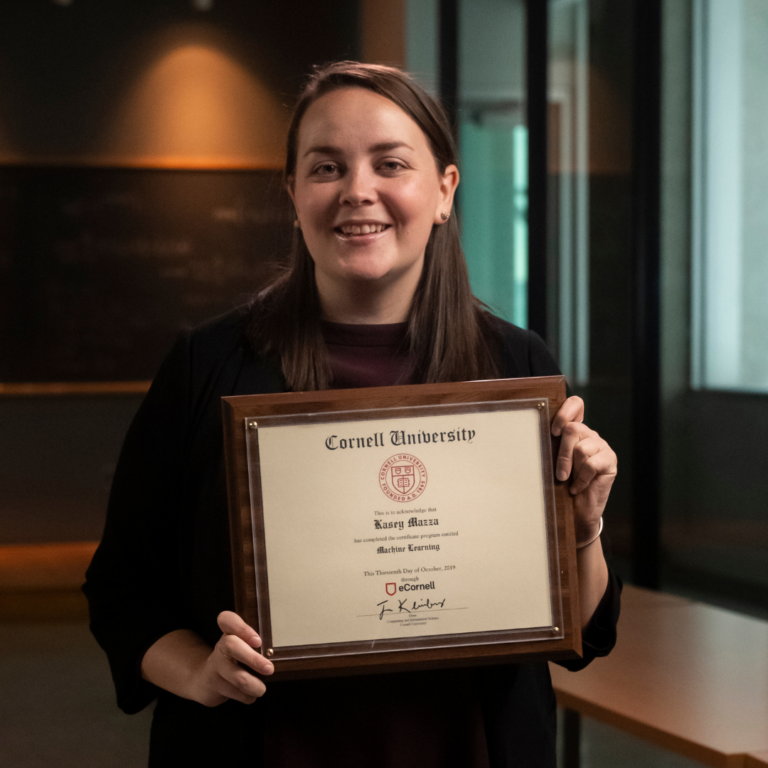
- Machine Learning Certificate from Cornell Bowers Computing and Information Science
- 144 Professional Development Hours (14.4 CEUs)
Watch the Video
Who Should Enroll
- Programmers
- Developers
- Data analysts
- Statisticians
- Data scientists
- Software engineers
Frequently Asked Questions
Machine learning is now a practical requirement for building smarter products, improving operations, and turning data into decisions. As AI capabilities expand across industries, the professionals who can translate real problems into well-scoped models, evaluate results correctly, and improve performance methodically become far more effective partners to technical teams and business stakeholders.
Authored by faculty from the Cornell Bowers College of Computing and Information Science, Cornell’s Machine Learning Certificate equips you to implement core machine learning approaches in Python while building the math-and-intuition foundation that helps you choose the right model for the job. You will practice supervised learning end to end, from framing a problem and selecting a loss function to training, tuning, and debugging models. Along the way, you’ll also work with modern neural networks and transformer-based generative models for text and images.
If you want hands-on Python implementation skills, a rigorous understanding of why algorithms work, and the confidence to select and improve models on real data, you should choose Cornell's Machine Learning Certificate.
Many online machine learning courses are designed for solo, self-directed consumption. Cornell’s Machine Learning Certificate is built around applied practice with structure, accountability, and expert support so you don’t just recognize concepts; you learn to implement and troubleshoot them.
Several design choices set the experience apart:
- Small, cohort-based learning that promotes active discussion and learning alongside a global group of professionals
- Expert facilitator guidance and feedback on your submitted work, including graded, competency-based projects tied to the algorithms you are implementing
- Live interactive sessions that help you pressure-test your understanding, ask implementation questions, and learn from how others approach similar problems
- A deliberate emphasis on both mathematical foundations and practical coding, including implementing core algorithms, evaluating models with appropriate loss functions, and improving performance through model selection and ensembling
- Built-in coding support, including an in-course Coding Coach tool used in the programming exercises to help you interpret errors and concepts while you work
The result is a program that teaches you how to think like a machine learning practitioner, not just how to run a library function.
Enrolling in Cornell's Machine Learning Certificate also provides you with a 6-month All-Access Pass to eCornell's live online AI Workshops, interactive sessions led by world-class Cornell faculty that combine Ivy League insight with practical applications for busy professionals. Each 3-hour Workshop features structured instruction, guided practice, and real tools to build competitive AI capabilities, plus the opportunity to connect with a global cohort of growth-oriented peers. While AI Workshops are not required, they enhance certificate programs through:
- Integrating AI perspectives across most curricula
- Responding to emerging AI developments and trends
- Offering direct engagement with Cornell faculty at the forefront of AI research
Cornell's Machine Learning Certificate is a strong fit if you build, analyze, or operationalize data-driven solutions and want to deepen your ability to implement machine learning models correctly in code. The program is designed for:
- Programmers and software engineers who want to add practical ML implementation skills
- Data analysts and data scientists who want a more rigorous grounding in model assumptions, evaluation, and debugging
- Developers and technical professionals who want to understand modern approaches spanning classic supervised learning, model selection, and deep learning
Because the Machine Learning Certificate curriculum is challenging, readiness matters. You do not need prior machine learning experience, but you will be most successful if you already have experience with Python and comfort with math topics such as probability, statistics, multivariate calculus, and linear algebra. Optional self-paced linear algebra lessons and a readiness pretest are provided to help you confirm or refresh the specific computations used in the program.
Project work in Cornell's Machine Learning Certificate is designed to move you from understanding an algorithm conceptually to implementing, evaluating, and improving it in code. You will complete hands-on programming projects in Python (using NumPy and Jupyter Notebooks) that reflect common supervised learning workflows.
Typical projects include:
- Framing a real problem as a supervised learning task, choosing features and labels, selecting a loss function, and defining a train/validation/test split
- Implementing k-nearest neighbors and building a working face-recognition prototype, including efficient vectorized distance computations
- Estimating distributions from data and implementing a Naive Bayes classifier to build a name-based classification system
- Implementing linear classifiers such as the perceptron and logistic regression, then training a spam email classifier using gradient descent
- Building decision trees with CART and applying cross-validation and grid search to tune hyperparameters and select a model
- Debugging model performance using bias-variance analysis, then improving results with ensemble methods like bagging and boosting
- Training maximum-margin classifiers with support vector machines and extending them to non-linear boundaries with kernels
- Building and training neural networks, adapting them for images with convolutional networks, and modeling text sequences for tasks like sentiment analysis
- Building a small transformer language model for text generation and experimenting with modern image-generation approaches such as diffusion-based methods
Throughout Cornell's Machine Learning Certificate program, you will repeatedly practice the skills that matter most in real work: making assumptions explicit, measuring performance correctly, and iterating based on evidence.
Cornell's Machine Learning Certificate helps you strengthen your credibility and effectiveness in machine learning work by building real implementation skill, better model judgment, and a repeatable approach to improving performance.
After completing the Machine Learning Certificate, you will be prepared to:
- Redefine problems using machine learning concepts and terminology
- Create a face recognition system using a simple algorithm
- Estimate probabilities distributions from data and implement the naive Bayes algorithm to create a name classifier
- Apply convex optimization and implement a linear classifier to create an email spam filter
- Use effective hyperparameter search to select a well-suited machine learning model and implement a machine learning setup from start to finish
- Improve the prediction accuracy of an algorithm using bias-variance trade-off
- Extend the applicability of linear classifiers to learn non-linear decision boundaries from more complex datasets
- Train a neural network that achieves cutting-edge accuracy by incorporating appropriate assumptions about your data
- Build generative models to create text and image outputs
Students commonly describe leaving the program with deeper competence, not just familiarity. Feedback highlights a strong focus on the math and intuition behind models, hands-on Python and NumPy practice that reinforces real ML workflows, and applied projects that help cement concepts. Learners also point to clear progression across foundational methods and modern topics, frequent practice and knowledge checks, and strong support from facilitators and teaching assistants, all of which can translate into more confidence contributing to data science and AI initiatives.
What truly sets eCornell apart is how our programs unlock genuine career transformation. Learners earn promotions to senior positions, enjoy meaningful salary growth, build valuable professional networks, and navigate successful career transitions.
Cornell’s Machine Learning Certificate, which consists of 10 short courses, is designed to be completed in 4 months. Each course runs for 2 weeks, with a typical weekly time commitment of 6 to 9 hours.
Flexibility comes from a hybrid structure. Most learning activities, including videos, readings, coding exercises, and project work, can be completed on your schedule each week. At the same time, the experience stays interactive through cohort discussions and opportunities for live sessions led by an expert facilitator, giving you opportunities to ask questions and learn alongside peers while keeping the majority of the work asynchronous.
If you want to move faster through a course, the short-course format can make it possible to accelerate when your schedule allows, as long as you can keep up with the weekly deliverables and coding practice.
Students in Cornell's Machine Learning Certificate frequently describe the experience as a well-orchestrated learning journey that builds real competence, not just familiarity, by pairing rigorous fundamentals with hands-on coding and applied projects.
Learners often highlight outcomes like these:
- A strong focus on the math and intuition behind machine learning models, not only implementation
- Hands-on Python and NumPy coding practice that reinforces core ML workflows
- Applied projects that connect directly to the lesson examples and help cement concepts
- Clear progression through foundational methods like k-nearest neighbors, kernels, ERM, and decision trees
- Exposure to modern topics such as deep learning, neural networks, LLMs, and transformer concepts
- Opportunities to translate algorithms into practical, business-oriented problem solving
Across the Machine Learning Certificate, learners also emphasize the quality of the learning experience:
- Well-structured modules with a logical, step-by-step flow
- Short, focused lessons that fit a working professional’s schedule
- Frequent practice activities and knowledge checks to support retention
- Strong facilitator and teaching assistant support, including detailed feedback on assignments
- Clear video instruction and well-documented course materials that are easy to revisit
Overall, students say Cornell’s Machine Learning Certificate is a challenging, engaging way to refresh and deepen technical skills, gain confidence applying machine learning techniques, and leave with tools they can use on real-world problems.
Prior preparation will make the experience smoother because the work is implementation-heavy and mathematically grounded. Cornell's Machine Learning Certificate does not require prior machine learning experience, but you are strongly encouraged to come in with Python familiarity and comfort with core math topics used in ML.
The recommended background includes probability and statistics, multivariate calculus, and linear algebra. To help you refresh what you need, the Machine Learning Certificate includes optional self-paced lessons focused on the specific linear algebra computations used in the coursework as well as a readiness pretest so you can check your starting point before you dive into the coding projects.
Modern model families are included alongside the classic foundations. In Cornell's Machine Learning Certificate, you will first build strong supervised-learning fundamentals then extend into neural networks for multiple data types and transformer-based approaches used in generative AI.
You will work with neural networks and learn how training choices like stochastic gradient descent, regularization, dropout, and batch normalization affect performance. You’ll also explore models designed for images and text, including convolutional networks and sequence models, then practice implementing a small transformer language model for text generation. On the generative AI side, the curriculum also introduces ways to generate or transform images, including diffusion-based approaches and related architectures used in modern image generation workflows.
The focus stays practical throughout Cornell's Machine Learning Certificate, with coding activities and projects that help you connect the building blocks to the outputs you see from today’s AI systems.
The work in Cornell's Machine Learning Certificate is built around practical coding in Python. You will use Python and the NumPy library extensively, and you’ll complete projects in Jupyter Notebooks.
For some deep learning and generative AI assignments, the Machine Learning Certificate curriculum also includes hands-on exposure to a modern deep learning framework like PyTorch (as demonstrated in the Deep Learning and Neural Networks course). Coding exercises are delivered in a browser-based environment, and the courses specify using a desktop browser such as Chrome or Firefox for the coding components.
Because Cornell's Machine Learning Certificate emphasizes implementation, planning for steady time to code each week is just as important as meeting the technical requirements.
Explore Related Programs
















- 2 to 6 months
- $2,000 to $10,000
- Online

- 2 to 4 weeks
- $299 to $1,199
- Online

- 3 hours
- $449
- Online

- 15 to 24 months part-time
- Tuition varies
- In person or online
- 2 to 5 days
- $3,000 to $10,000
- In person - Ithaca or NYC
- Custom Enterprise Programs
- Price varies
- In person or hybrid
Request Information Now by completing the form below.

Machine Learning
| Select Payment Method | Cost |
|---|---|
| $3,900 | |