

Kyle Harms received his Ph.D. in Computer Science in 2017 at Washington University in St. Louis. Under the supervision of Dr. Caitlin L. Kelleher, he investigated leveraging completion problems to help enable middle school students to learn computer programming independently. He has completed and published research on a variety of topics relating to young learners and learning how to code, both through structured programs and through self-taught methods. His software work is available on the novice programming environment, Looking Glass, and the open source program github.

Web Design and DevelopmentCornell Certificate Program
Web Design and Development (CISC02)
Enroll Now
Online
$3,750
Request More Info
More Info
Overview and Courses
This front-end web development certificate is all about designing and building websites that are focused on the needs of users, striking a balance between form and function. From the very beginning, you will explore the ideas of mental models and target audience personas. By taking a design-first, code-second approach, you will learn to structure content and make informed design decisions based on the needs of potential website visitors before writing a single line of code. Foundational concepts of writing valid HTML and CSS are paired with accessibility best practices to ensure you can implement your designs effectively and accurately. Through an introduction to JavaScript, jQuery, and data collection, you will explore adding simple interactivity and forms to your websites. Throughout these courses, you will practice meeting the needs of your target audiences while designing web experiences that are attractive, functional, and accessible.
The courses in this certificate program are required to be completed in the order that they appear.
Course list
In this course, students go beyond the code to understand what is really important in web development. Through creating a mental model of how web development works, student are exposed to the big picture of how users interact with websites. By building empathy and an understanding of target audience needs, students recognize the benefits of approaching design from the perspective of the user and the importance of accessibility, biases, and cultural sensitivity. Finally, students dive into the inner workings of the web to remove the mystery and build a clear picture of how websites work. Ultimately, the goal of this course is to prepare students to design and build beautiful, functional websites that meet the needs of their target audience.
View Course Start Dates Hide Course Start Dates
View Course Details- Dec 2, 2026
- Jan 13, 2027
- Feb 24, 2027
- Apr 7, 2027
- May 19, 2027
- Jun 30, 2027
- Aug 11, 2027
In this course, students will start by identifying the various types of elements that exist in a web page and the importance of information architecture. They will immediately begin organizing and structuring web page content and then markup the content using HTML. This process will introduce the document object model, which enables students to build a mental model of how web pages are built and how web browsers render those pages. Important facets of writing valid HTML that is also semantically sound are introduced through a number of code writing activities. From single page coding, we zoom out to explore how websites with multiple pages, hyperlinks, and navigation are organized and developed. Students will take these new skills and apply them to building a simple multi-page website with valid code and a functional navigation.
View Course Start Dates Hide Course Start Dates
View Course Details- Nov 4, 2026
- Dec 16, 2026
- Jan 27, 2027
- Mar 10, 2027
- Apr 21, 2027
- Jun 2, 2027
- Jul 14, 2027
In this course, students will engage in a design-first approach, focusing on understanding the needs of the user and prioritizing designing over coding. By engaging with personas and gaining empathy for a website's audience, students identify the needs of their users and apply visual design principles to make sites accessible. With designs in hand, students will learn to write Cascading Style Sheets (CSS) and create rules to implement their design. Along with writing and implementing CSS code, students will explore validating, troubleshooting, and improving their CSS using various techniques, including by leveraging generative AI.
View Course Start Dates Hide Course Start Dates
View Course Details- Nov 18, 2026
- Dec 30, 2026
- Feb 10, 2027
- Mar 24, 2027
- May 5, 2027
- Jun 16, 2027
- Jul 28, 2027
In this course, you will employ visual design practices and principles to create attractive, functional websites styled with CSS. Through a thorough investigation of the CSS box model, you are introduced to concepts such as padding, margin, whitespace, and element sizing. These concepts are then given the context of visual design principles to help you make layout and design choices that are user-centric and functional. You will then practice the layout design process to create sketches and wireframes of your designs. With plans in place, you will then write CSS to implement the design to effectively style and layout HTML elements accurately. Finally, you will go a step further to ensure this design is flexible and responsive on the many devices that could be used to visit your site.
View Course Start Dates Hide Course Start Dates
View Course Details- Dec 2, 2026
- Jan 13, 2027
- Feb 24, 2027
- Apr 7, 2027
- May 19, 2027
- Jun 30, 2027
- Aug 11, 2027
In this course, you will explore the potential of interactivity by adding JavaScript to a website. First, you will consider the use of interactivity and identify some common best practices and pitfalls. You will then dive into the JavaScript language, practicing the basics of JS syntax and jQuery. Next, you will discover event-based programming concepts such as event handlers, state, and conditionals. Finally, you will utilize various debugging techniques and leverage AI to help you debug both the syntax and logic of your JS code.
View Course Start Dates Hide Course Start Dates
View Course Details- Nov 4, 2026
- Dec 16, 2026
- Jan 27, 2027
- Mar 10, 2027
- Apr 21, 2027
- Jun 2, 2027
- Jul 14, 2027
In this course, you will build a form to collect data input. This process begins with analyzing how web requests work and identifying the parameters of the hypertext transfer protocol (HTTP). Next, you will design and code a form to collect user data. You'll use advanced topics such as client-side form validation and error messages to improve the user experience and overall validity of collected data. You will then evaluate your form and implementation to ensure the final design is appropriate and functional.
View Course Start Dates Hide Course Start Dates
View Course Details- Nov 18, 2026
- Dec 30, 2026
- Feb 10, 2027
- Mar 24, 2027
- May 5, 2027
- Jun 16, 2027
- Jul 28, 2027
eCornell online Workshops are live, interactive learning experiences lasting 1 to 4 hours and led by Cornell faculty experts. These premium, short-format sessions focus on AI topics and are designed for busy professionals who want to gain immediately applicable skills and strategic perspectives. Workshops may include faculty presentations, breakout discussions, and guided hands-on practice.
The AI Workshops All-Access Pass provides you with unlimited participation for 6 months from your date of purchase. Whether you choose to attend one Workshop per month or several per week, the All-Access Pass allows you to customize your AI journey and stay on top of the latest AI trends.
Hosted by Cornell faculty at the forefront of their fields, Workshops cover a range of cutting-edge AI topics applicable across industries. Workshops are offered at three levels to allow you to choose topics that match your experience.
- AI Foundations
- These Workshops introduce core AI concepts, terminology, capabilities, limitations, and practical applications. No prior AI experience is required.
- Best for: Beginners, AI-curious professionals, and teams starting their AI journey.
- AI in Practice
- These Workshops focus on practical skills, workflows, and strategies that help participants use AI more effectively in their day-to-day work. Some familiarity with AI tools is recommended.
- Best for: Professionals who have experimented with AI and want to build confidence and capability.
- AI Leadership and Transformation
- These advanced Workshops explore emerging technologies, strategic implementation, governance, organizational impact, and specialized applications. AI fluency is expected, and some Workshops may have prerequisites.
- Best for: AI leaders, transformation teams, executives, and advanced practitioners.
Request more Info by completing the form below.
more Info
by completing the form below.Act today—courses are filling fast.
How It Works
Format
All Online
Time Commitment
3 months with 7 to 10 hours of study per week
Cost
$3,750
Learn From Top Minds
Courses are developed by Cornell faculty.
Power Your Career
Gain today’s most in-demand skills to stand apart.
Flexibility Fits Your Life
Learn on your schedule without stepping out of your job.
Small-class Experience
Participate in facilitated discussions and live sessions with industry peers.
Real-world Projects
Apply learnings and insights to your work to make an impact right away.
Personalized Feedback
Enjoy meaningful feedback on assignments from expert facilitators.
Format
All Online
Time Commitment
3 months with 7 to 10 hours of study per week
Cost
$3,750
Learn From Top Minds
Courses are developed by Cornell faculty.
Power Your Career
Gain today’s most in-demand skills to stand apart.
Flexibility Fits Your Life
Learn on your schedule without stepping out of your job.
Small-class Experience
Participate in facilitated discussions and live sessions with industry peers.
Real-world Projects
Apply learnings and insights to your work to make an impact right away.
Personalized Feedback
Enjoy meaningful feedback on assignments from expert facilitators.
Faculty Author
Kyle Harms
Senior Lecturer
Cornell Bowers Computing and Information Science
Senior Lecturer, Cornell Computing and Information Science
Key Course Takeaways
- Establish a framework for success in front-end web development
- Produce valid HTML that organizes content in a meaningful way for your target audience
- Use CSS to design and implement a web page that is appropriate for your target audience
- Employ visual design principles to create attractive, functional websites styled and laid out with CSS
- Enhance the user experience through interactivity with JavaScript
- Recognize basic JavaScript & jQuery syntax rules and event-based programming techniques
- Design, code, and evaluate a form to collect data inputs from your target audience

Download Brochure
Fill out the form below to download program information and connect
with us.
Download a Brochure
Not ready to enroll but want to learn more? Download the certificate brochure to review program details.“
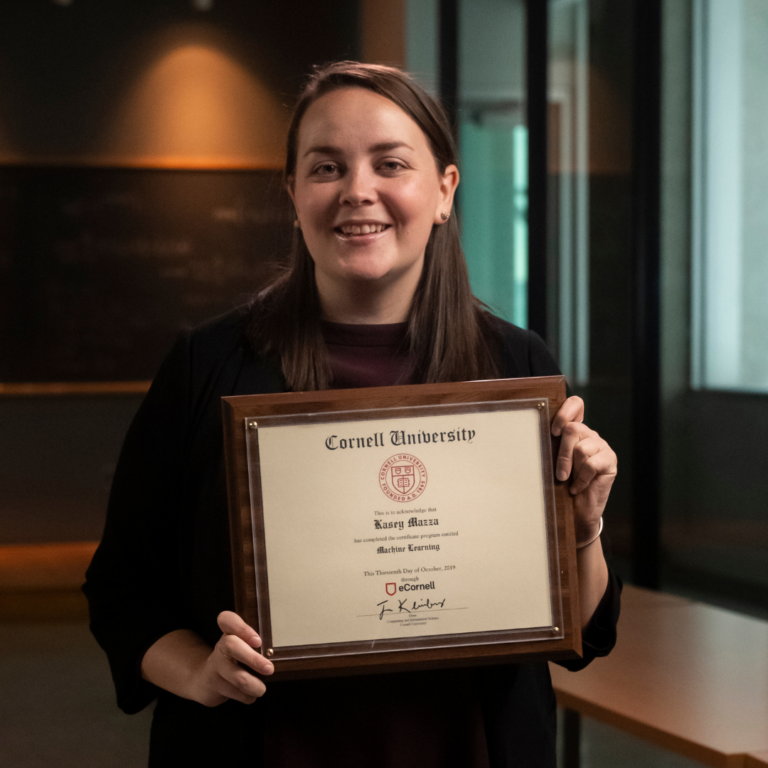
Completing a program from eCornell really has allowed me to think outside the box at work. It gave me the confidence I needed to take a seat at that table and say I am ready.
‐ Kasey M.
What You'll Earn
- Web Design and Development Certificate from Cornell Ann S. Bowers College of Computing and Information Science
- 60 Professional Development Hours (6 CEUs)
Watch the Video
Hear from the Web Design and Development certificate program faculty author.
Who Should Enroll
- Aspiring web developers, web designers, and UX designers
- Backend programmers who need front-end skills to become full-stack developers
- Self-taught web programmers
- Entrepreneurs
Frequently Asked Questions
Modern front-end work is not just about writing code. Employers and clients need professionals who can translate real user needs into clear structure, accessible design decisions, and reliable interactive experiences across devices and browsers. Cornell’s Web Design and Development Certificate helps you build that full, user-centered foundation.
In this certificate program, authored by faculty from the Cornell Bowers College of Computing and Information Science, you will practice how to think like a front-end developer, starting with mental models and target audiences, then moving into semantic HTML, accessible CSS styling, responsive layout, and purposeful interactivity. Along the way, you will learn how websites actually work on the web, how browsers interpret your code, and how to validate and debug issues systematically so you can improve quality with confidence.
If you want to design for real users, build accessible and responsive websites with modern front-end foundations, and develop the confidence to debug and improve your own code, you should choose Cornell's Web Design and Development Certificate.
Many online web development options focus on code snippets and quick tutorials, which can leave you guessing about why a solution works, how to adapt it for your users, or how to fix it when it breaks. Cornell’s Web Design and Development Certificate takes a different approach by building your ability to make sound decisions before you code, then giving you repeated practice implementing those decisions in HTML, CSS, and JavaScript.
You learn in a small, facilitated cohort where an expert facilitator guides discussion and provides feedback on your project work. That human support is paired with a structured learning experience that emphasizes real skill-building: semantic, valid markup; accessibility as a foundation; responsive layout techniques; and purposeful interactivity that improves usability rather than adding distraction.
Cornell’s Web Design and Development Certificate also teaches you how to work like a professional when you get stuck. You practice using reference documentation, validators, browser developer tools, and responsible AI support for troubleshooting so you can develop the habits that help you ship cleaner, more maintainable front-end work.
Enrolling in this certificate also provides you with a 6-month All-Access Pass to eCornell's live online AI Workshops, interactive sessions led by world-class Cornell faculty that combine Ivy League insight with practical applications for busy professionals. Each 3-hour Workshop features structured instruction, guided practice, and real tools to build competitive AI capabilities, plus the opportunity to connect with a global cohort of growth-oriented peers. While AI Workshops are not required, they enhance certificate programs through:
- Integrating AI perspectives across most curricula
- Responding to emerging AI developments and trends
- Offering direct engagement with Cornell faculty at the forefront of AI research
Cornell’s Web Design and Development Certificate fits professionals who want a practical, beginner-friendly path into front-end web design and development without losing sight of usability and accessibility. The Web Design and Development Certificate is a strong match if you:
- Are an aspiring web developer, web designer, or UX designer who wants to build credible front-end foundations
- Are a self-taught programmer looking to fill gaps in semantic HTML, CSS layout, and user-centered design
- Work on the back end and want to add front-end skills to move toward full-stack development
- Build or manage a business and want the ability to design, evaluate, and improve your own website experience
Because the coursework starts with mental models, target audiences, and accessibility before deeper implementation, you get structure and confidence as you move into HTML, CSS, interactivity, and forms.
You build skill by producing concrete work products that mirror real front-end tasks, from evaluating existing experiences to implementing and debugging your own pages.
In Cornell’s Web Design and Development Certificate, project work includes:
- Analyzing a real website through the lens of user mental models, target audiences, accessibility, and how the web delivers page resources
- Building a simple multi-page website with valid, semantic HTML and functional navigation, with attention to clean structure and file organization
- Designing a visual theme from a persona, then implementing it with CSS, refining selectors for specific elements, and debugging styles so your code validates
- Critiquing and redesigning layout using sketches and wireframes, then implementing responsive layouts with CSS spacing, flexbox, and media queries
- Adding purposeful interactivity using JavaScript and jQuery, including event-based behaviors and state-based toggling, followed by systematic debugging
- Creating an accessible contact form, choosing an appropriate HTTP method (GET or POST), implementing client-side validation and user-friendly error messages, and evaluating the experience with accessibility checks and a persona-based walkthrough
Across these projects, you practice making design decisions you can explain, then proving they work through valid code, testing, and iteration.
Cornell’s Web Design and Development Certificate helps you build credible front-end capability you can apply immediately, including designing for users, implementing accessible and responsive pages, and debugging issues across HTML, CSS, and JavaScript.
After completing the Web Design and Development Certificate, you will have the skills to:
- Establish a framework for success in front-end web development
- Produce valid HTML that organizes content in a meaningful way for your target audience
- Use CSS to design and implement a web page that is appropriate for your target audience
- Employ visual design principles to create attractive, functional websites styled and laid out with CSS
- Enhance the user experience through interactivity with JavaScript
- Recognize basic JavaScript & jQuery syntax rules and event-based programming techniques
- Design, code, and evaluate a form to collect data inputs from your target audience
Students commonly describe long-term benefits that go beyond learning syntax. Many report increased confidence and a clearer understanding of how websites work, which helps them make better design decisions and communicate more effectively about accessibility, responsive layouts, and browser differences. Learners also highlight project-based assignments that feel like workplace scenarios, plus practical experience testing, troubleshooting, and improving front-end behavior. The result is a stronger ability to contribute to real web projects, whether you are building new pages, improving an existing site’s usability, or collaborating more productively with designers and developers.
In addition, because eCornell represents the pinnacle of premium online professional education, participants in eCornell's programs often experience long-term career transformation such as promotions to more senior roles, salary increases, improved networking opportunities, and successful career transitions.
Cornell’s Web Design and Development Certificate, which consists of 6 short courses, is designed to be completed in 3 months. Each course in this certificate runs for 2 weeks, with a typical weekly time commitment of 7 to 10 hours.
Most of the work is asynchronous, so you can complete readings, videos, coding activities, and project steps on your own timeline each week. Opportunities for live sessions support discussion and Q&A, but the core flexibility comes from being able to do the majority of coursework when it fits your schedule while still having clear milestones to keep you moving.
Students in Cornell’s Web Design and Development Certificate often describe the experience as a practical, confidence-building way to understand how websites work and to start creating them with a user-first mindset. They frequently highlight how the program blends clear instruction with hands-on application so they can immediately connect concepts like accessibility, responsive layouts, and browser differences to real design decisions.
What students most often emphasize includes:
- A stronger ability to design for real users, including accessibility and usability
- Hands-on practice with browser testing, keyboard navigation, and responsive design thinking
- A clearer understanding of how the web and web pages function before deeper coding begins
- Project-based assignments that feel like real workplace scenarios
- Practical experience debugging and improving front-end behavior
- A beginner-friendly on-ramp that helps nontechnical learners build confidence with web concepts
- A well-paced, modular structure that makes complex topics feel manageable
- Short, focused lessons and tutorials that make it easier to retain key ideas
- A flexible online format that fits around full-time work and busy schedules
- Supportive, responsive facilitators who provide helpful guidance and feedback
- A learning platform that is easy to navigate and keeps students on track with milestones and due dates
Many students also say they leave Cornell’s Web Design and Development Certificate with more than just theory; they feel prepared to apply what they learned immediately, whether that means evaluating a site through a UX lens, improving accessibility decisions, or making front-end updates with greater confidence.
You will build a well-rounded front-end foundation that combines user-centered design thinking with hands-on implementation.
In Cornell’s Web Design and Development Certificate, you will work with:
- User-centered methods like mental models, target audiences, and personas to guide design decisions
- Accessibility practices, including the POUR principles, semantic structure, keyboard navigation, and assistive-technology considerations
- HTML for valid, semantic page structure, multi-page organization, hyperlinks, and navigation
- CSS for theming, typography, color and contrast, layout fundamentals, flexbox, and responsive media queries
- JavaScript and jQuery for event-based interactivity, DOM updates, and state-based behaviors
- Forms and data collection concepts, including HTTP requests, GET vs POST, and client-side validation with clear error messaging
- Professional workflow habits such as using MDN reference documentation, validators, and browser developer tools for troubleshooting
The result is practical coverage of what you need to design, build, and improve modern front-end experiences.
Accessibility is treated as a starting point, not a final checklist. Cornell’s Web Design and Development Certificate teaches you to design for diverse users from the beginning, then carry those decisions through your HTML structure, CSS styling, and interactive behaviors.
You will practice accessibility and inclusiveness by:
- Evaluating experiences using established accessibility principles (including the POUR framework)
- Experiencing common barriers through activities like keyboard navigation and assistive-technology simulations
- Writing semantic, valid HTML and navigation structures that support screen readers and predictable interaction
- Designing with personas and considering how culture, cognitive styles, and self-efficacy can influence usability
- Building interactive elements that remain functional and discoverable, including clear affordances and feedback for keyboard and screen-reader users
- Designing forms with clear labels and supportive error messaging, then evaluating the experience using an accessibility checklist and a persona-based walkthrough
These habits help you build front-end experiences that are more usable for everyone and easier to maintain over time.
Expect to spend most of your time actively building, testing, and improving front-end work products, not just watching videos. Cornell’s Web Design and Development Certificate uses short lessons and interactive exercises to introduce concepts, then asks you to apply them in graded projects that build your skills step by step.
Support is built into the learning experience. You learn alongside a small cohort, guided by an expert facilitator who provides feedback on your submissions and helps keep you on track through discussions and opportunities for live sessions. You also practice using the same tools and habits developers rely on, including reference documentation, validators, browser developer tools, and structured debugging checklists, so you are learning the process, not just the answer.
Explore Related Programs

















Explore programs to meet your professional goals
Certificates

Earn a Cornell credential as you complete multiple courses.
- 2 to 6 months
- $2,000 to $10,000
- Online
Courses

Learn in a small cohort, with graded assignments and opportunities for live sessions.
- 2 to 4 weeks
- $299 to $1,199
- Online
Workshops

Develop AI skills and strategies in interactive sessions with Cornell faculty.
- 3 hours
- $449
- Online
Degrees

Earn a professional master’s degree from Cornell University.
- 15 to 24 months part-time
- Tuition varies
- In person or online
On Campus

Join us in Ithaca or NYC to engage with peers and experts from around the world.
- 2 to 5 days
- $3,000 to $10,000
- In person - Ithaca or NYC
Programs for Teams

Address strategic challenges with Cornell University faculty to develop the skills required for organizational success.
- Custom Enterprise Programs
- Price varies
- In person or hybrid
Request Information Now by completing the form below.
Act today—courses are filling fast.
Purchase Options
3750

Web Design and Development
| Select Payment Method | Cost |
|---|---|
| $3,750 | |
Review Program Pricing and Details