
Course list

Developing and launching new products involves more than a great idea. In today's fast-paced digital economy, understanding your target customers and their specific needs is essential to launching and managing successful products. In startups and established companies alike, the product manager serves as a key player in taking a product from idea to launch to success.

To bring viable products to market, a successful product manager needs to balance creative inspiration with a disciplined approach. Articulating a winning product means beginning with a hypothesis: You need to craft a simple statement that says, "We are going to help Person X solve Problem Y by doing Z," thus defining a specific customer, a specific problem, and a solution. In this course, you will do just that: Talk to customers, define problems, and come up with a product strategy and a plan for how you would actually build that product.

In this course, you will map your customer's journey and build personas. In doing so, you‘ll position yourself with a much clearer picture of the real problem your product is trying to solve, paving the way for a strong product strategy.

  • Apr 22, 2026
  • May 6, 2026
  • May 20, 2026
  • Jun 3, 2026
  • Jun 17, 2026
  • Jul 1, 2026
  • Jul 15, 2026

Have you ever thought about why some products succeed and some fail? A product manager is responsible for the product's success. This all begins with setting a vision for the future where your stakeholders visualize how your product will improve your customers' lives. From there, you can begin to break down the specific goals you need to accomplish to make this future a reality. That helps you set the vision and articulate what a winning product looks like.

Visualizing and drawing the business is an important step in the process. In this course, you will discover how to break your business down into pieces so that you can carefully develop a winning strategy and focus on what matters. You'll examine how to visualize and draw the business, then identify the objectives and key results you'll rally the team to achieve.

The following course is required to be completed before taking this course:

  • Developing a Product Hypothesis and Personas
  • May 6, 2026
  • May 20, 2026
  • Jun 3, 2026
  • Jun 17, 2026
  • Jul 1, 2026
  • Jul 15, 2026
  • Jul 29, 2026

Product strategy is the critical link between your organization's long-term vision and its short-term execution. As a product manager, your ability to craft a clear strategy and roadmap — while gaining buy-in from key stakeholders — positions you to lead product development teams with confidence and impact.

In this course, you will discover how to define a structured framework for prioritization; source ideas from customers, team members, and stakeholders; and make informed decisions about which product features to pursue. You'll then apply these skills to build a backlog of high-impact projects and create a compelling product roadmap that clearly communicates what's coming next — as well as why it matters.

The following courses are required to be completed before taking this course:

  • Developing a Product Hypothesis and Personas
  • User Personas and Product Vision
  • Apr 22, 2026
  • May 6, 2026
  • May 20, 2026
  • Jun 3, 2026
  • Jun 17, 2026
  • Jul 1, 2026
  • Jul 15, 2026

You have already done the work to answer critical questions regarding your target customer, your product, and the problem that your product will solve. Now it's time to design your product. In this course, you will address the product question, “How do we solve the problem in a way that delights our users and fits our strategy?”

You will examine how to create a prototype that simulates the product experience just well enough to get valuable feedback from potential customers. You'll also examine strategies for aligning the team and create a staffing plan that defines the team members, their roles and responsibilities, and potential areas for friction. You'll finish by writing a product requirements document (PRD), which is a pillar artifact that will rally the team and kick off the engineering and execution phase. This is an exciting moment when you prepare to pivot from analysis and planning to designing and building.

The following courses are required to be completed before taking this course:

  • Developing a Product Hypothesis and Personas
  • User Personas and Product Vision
  • Apr 22, 2026
  • May 6, 2026
  • May 20, 2026
  • Jun 3, 2026
  • Jun 17, 2026
  • Jul 1, 2026
  • Jul 15, 2026

After launching a minimum viable product, a product manager needs to measure what's working and what's not then make quick adjustments. This is a key area in the product management process.

In this course, you will identify strategies for measuring progress, validating or updating product hypotheses, and presenting a path forward. You'll use recommended best practices to collect data to make calculated and informed decisions. You'll present what you have learned, propose related adjustments to your product strategy and roadmap, and consider your team's culture as you decide how to learn and iterate.

The following courses are required to be completed before taking this course:

  • Developing a Product Hypothesis and Personas
  • User Personas and Product Vision
  • Apr 22, 2026
  • May 6, 2026
  • May 20, 2026
  • Jun 3, 2026
  • Jun 17, 2026
  • Jul 1, 2026
  • Jul 15, 2026

You made it this far by focusing on the customer, setting clear objectives and key results, building a roadmap, and determining how to articulate product learnings and make adjustments. The product manager now moves from planning and analyzing to building and launching a product.

In this course, you will identify strategies for partnering with an engineering team on a day-to-day basis as your team writes and releases code. You'll examine best practices for planning an engineering sprint, writing user stories, and managing and resolving issues. A product manager is accountable for building a delightful customer experience and achieving key objectives; you'll discover how to bring it all together so you can work with your team to build a successful product.

The following courses are required to be completed before taking this course:

  • Developing a Product Hypothesis and Personas
  • User Personas and Product Vision
  • Apr 22, 2026
  • May 6, 2026
  • May 20, 2026
  • Jun 3, 2026
  • Jun 17, 2026
  • Jul 1, 2026
  • Jul 15, 2026

eCornell Online Workshops are live, interactive 3-hour learning experiences led by Cornell faculty experts. These premium short-format sessions focus on AI topics and are designed for busy professionals who want to gain immediately applicable skills and strategic perspectives. Workshops include faculty presentations, breakout discussions, and guided hands-on practice.

The AI Workshops All-Access Pass provides you with unlimited participation for 6 months from your date of purchase. Whether you choose to attend one workshop per month, or several per week, the All-Access Pass will allow you to customize your AI journey and stay on top of the latest AI trends.

Workshops cover a range of cutting-edge AI topics applicable across industries, hosted by Cornell faculty at the forefront of their fields. Whether you are just getting started with AI, seeking to build your AI skillset, or exploring advanced applications of AI, Workshops will provide you with an action-oriented learning experience for immediate application in your career. Sample Workshops include:

  • Work Smarter with AI Agents: Individual and Team Effectiveness
  • Leading AI Transformation: Bigger Than You Imagine, Harder Than You Expect
  • Using AI at Work: Practical Choices and Better Results
  • Search & Discoverability in the Era of AI
  • Don't Just Prompt AI - Govern it
  • AI-Powered Product Manager
  • Leverage AI and Human Connection to Lead through Uncertainty

Request
more Info
by completing the form below.

Act today—courses are filling fast.

How It Works

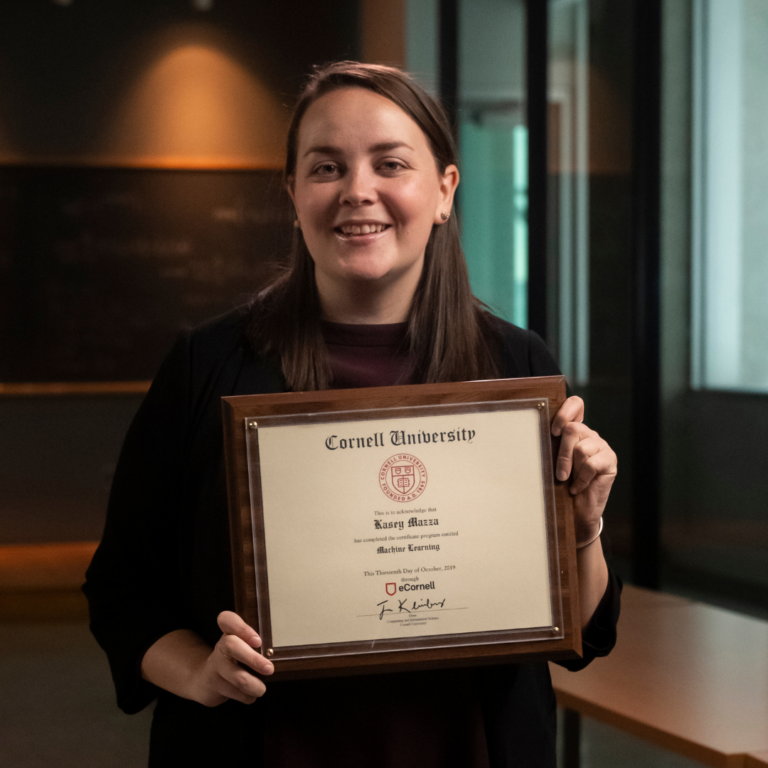
Completing a program from eCornell really has allowed me to think outside the box at work. It gave me the confidence I needed to take a seat at that table and say I am ready.
‐ Kasey M.
Kasey M.

Frequently Asked Questions

Modern product teams are expected to ship quickly while still staying deeply customer driven. That means you need more than instincts and frameworks; you require a repeatable process for turning real customer problems into a product vision, a prioritized roadmap, clear requirements, and measurable outcomes.

In Cornell’s Product Management Certificate, authored by faculty from Cornell Tech, you will build end-to-end product management capability across the full product life cycle. You will practice customer discovery through journey mapping, interviews, and personas; define a product vision as well as objectives and key results (OKRs); make trade-offs and prioritize a roadmap; prototype and write a product requirement document (PRD) for a minimum viable product (MVP); then use product analytics and agile execution practices to iterate and deliver.

Throughout the program, you learn by doing. Course projects are designed to mirror real product management (PM) work products and decisions, and you will receive guidance and feedback from an expert facilitator while learning alongside a small cohort of peers.

If you want a customer-centered product process, practical deliverables you can use at work, and the confidence to lead cross-functional execution, you should choose Cornell’s Product Management Certificate.

Cornell’s Product Management Certificate is built for professionals who want to perform like a product manager, not just learn product management concepts.

First, you learn in an intimate, facilitated cohort. Instead of working entirely on your own, you engage in structured discussions, apply frameworks to your own context, and receive feedback from an expert facilitator on the work you submit.

Second, the learning is organized around real PM deliverables that compound across the program. You will create customer journey maps and personas, write a product vision and OKRs, build a prioritized backlog and visual roadmap, prototype key user flows, write a PRD for an MVP, design a metrics dashboard, and plan sprints and tickets for an engineering team.

Finally, the curriculum reflects how product work actually happens. You practice balancing qualitative discovery with quantitative measurement, making trade-offs under uncertainty, communicating decisions to stakeholders, and iterating based on evidence.

Enrolling in Cornell’s Product Management Certificate also provides you with a 6-month All-Access Pass to eCornell's live online AI Workshops, interactive sessions led by world-class Cornell faculty that combine Ivy League insight with practical applications for busy professionals. Each 3-hour Workshop features structured instruction, guided practice, and real tools to build competitive AI capabilities, plus the opportunity to connect with a global cohort of growth-oriented peers. While AI Workshops are not required, they enhance certificate programs through:

  • Integrating AI perspectives across most curricula
  • Responding to emerging AI developments and trends
  • Offering direct engagement with Cornell faculty at the forefront of AI research

Cornell’s Product Management Certificate is designed for professionals who want to lead product work with more structure, confidence, and customer clarity.

The Product Management Certificate is a strong fit if you are:

  • A current or aspiring product manager building end-to-end PM fundamentals
  • A product marketing manager, designer, or engineer who partners closely with product and wants stronger shared frameworks for discovery, prioritization, and execution
  • A business or data analyst who wants to connect insights to product strategy, metrics, and decisions
  • An entrepreneur or small business owner who needs a repeatable process for defining what to build, validating demand, and iterating toward product-market fit
  • A professional transitioning into the tech industry and looking for practical, job-relevant PM deliverables

The program is designed to be practical and workplace relevant, with projects that mirror the artifacts and decisions product teams use every day.

In Cornell’s Product Management Certificate, you complete hands-on projects designed to reflect real product management work, from customer discovery through mock interviews to execution and iteration. Past learners have applied the program frameworks to projects such as:

  • Designing an AI-powered sign-to-sign translation mobile app that supports real-time cross-sign language communication with text and avatar outputs for users who are deaf and hard of hearing
  • Building a secure voice platform that combines intent understanding with voice-based authentication to speed contact center routing while reducing verification friction and fraud risk
  • Creating a centralized loan-closing workspace that autogenerates requirement checklists, assigns ownership, tracks documents, and surfaces bottlenecks through dashboards and notifications
  • Developing a schedule management assistant that unifies multiple calendars, improves onboarding clarity, and uses reminders and conflict signals to reduce missed commitments for busy professionals
  • Prototyping an adaptive learning product that lets the user set pace, format, and accessibility preferences so the content experience adjusts to how the users learns rather than forcing a single path

As you move through the program, you will translate your chosen product idea or product area into core PM deliverables, such as customer journey maps and personas, a product vision and OKRs, a prioritized roadmap, a prototype, a PRD for an MVP, and a measurement and iteration plan.

You will strengthen the practical product management skills that help you move from idea to execution with clearer decisions and stronger cross-functional alignment.

After completing Cornell’s Product Management Certificate, you will be able to:

  • Define a single problem the product solves for customers
  • Perform user research, map the customer journey, and create target personas
  • Define the product vision, key drivers of success, and the most critical goals
  • Validate hypotheses about your users, product, and business
  • Create a compelling product roadmap that articulates what you plan to build
  • Design a product prototype
  • Develop your MVP
  • Plan a product sprint and outline work for an engineering team
  • Analyze product data to measure success and inform the next iteration of the product

Students consistently describe this program as practical and job relevant, with coursework they could apply immediately in their day-to-day roles. Learners most often highlight clearer product thinking and stronger customer-centricity, plus concrete skill gains such as writing stronger PRDs; prototyping in a structured way; conducting customer discovery through interviews, personas, and journey mapping; defining product vision and OKRs; using roadmapping and prioritization frameworks; and applying product analytics to make better decisions. They also mention that facilitator feedback is detailed and helpful, and that concise modules and a flexible online format made it realistic to learn while working.

In addition, because eCornell represents the pinnacle of premium online professional education, participants in eCornell's programs often experience long-term career transformation such as promotions to more senior roles, salary increases, improved networking opportunities, and successful career transitions.

Cornell’s Product Management Certificate, which consists of 6 short courses, is designed to be completed in 3 months. Each course in this certificate runs for 2 weeks, with a typical weekly time commitment of 3 to 5 hours, and must be taken in order.

This certificate is geared toward working professionals who need flexibility while still benefiting from structure and momentum. In practice, you can complete most work on your own schedule each week, including videos, readings, and assignments. You also learn alongside a small cohort with facilitated discussions and occasional live elements that support peer learning and help you apply the material to your role.

Students consistently describe Cornell’s Product Management Certificate as a practical, job-relevant way to strengthen real PM skills through hands-on work, clear instruction, and high-touch facilitator support. Many say they were able to use what they learned immediately in their day-to-day roles and that the coursework helped them think more strategically and customer-centrically.

What students highlight most often includes:

  • Clear guidance on creating strong PRDs and improving product clarity
  • A structured approach to product prototyping, from early concepts to alignment and iteration
  • Customer discovery skills, including interview planning, persona development, and journey mapping
  • Product vision and goals work that helps with OKRs and defining what success looks like
  • Practical frameworks for roadmapping, prioritization, and translating ideas into an executable plan
  • Templates, tools, and examples that make it easier to apply concepts to real projects
  • Relevant coverage of product analytics to support better product decisions
  • Action-oriented assignments that mirror real workplace deliverables

Learners also frequently mention the learning experience itself: concise modules that are easy to follow, a flexible online format that fits busy schedules, and engaged facilitators who provide detailed, thoughtful feedback. They value learning alongside peers, noting that discussions and shared perspectives help them see product challenges from new angles. Overall, students say the program builds a strong foundation for newer product managers while still offering advanced insights and fresh approaches for experienced professionals.

You will explore agile principles and how they show up in day-to-day product execution, including how to plan and run sprints, groom and prioritize a backlog, and keep delivery on track.

You will also practice translating product intent into engineering-ready work, including writing user stories and tickets with clear requirements and definitions of “done.” Finally, you will examine launch practices such as issue triage, release planning, monitoring, and post-launch learning so you can help your team ship with confidence and respond quickly when reality changes.

You will learn how to choose metrics that match your product goals, design dashboards that help teams change behavior, and collect the right data so you can answer important product questions.

You will also practice validating hypotheses with data, including when and how to use A/B tests, how to define success metrics, and how to make decisions when results are mixed or incomplete. You finish by focusing on communication, including how to present learnings and recommend what to change in your roadmap based on evidence.

By the end of Cornell’s Product Management Certificate, you will have practiced producing the core artifacts product managers use to align teams and move work forward. Depending on your product context, that can include:

  • A customer journey map, interview plan, and user personas
  • A clear product vision and a set of OKRs
  • A prioritization approach, a backlog of initiatives, and a visual product roadmap you can present to stakeholders
  • A prototype of key user flows, plus a PRD that supports an MVP build * A metrics dashboard and a hypothesis and testing plan to guide iteration after launch
  • Sprint plans and engineering-ready user stories and tickets, plus a launch plan and issue-triage approach

These deliverables are intentionally practical, so you can adapt them to your current role, a new product idea, or a product you are improving.