Course list

This course provides an introduction to the programming environment and explores the basics of Python. After learning how to run a script, you will work with Python expressions, functions, and variables in interactive mode. By the end of the course, you will be able to write a basic Python script that includes built-in functions and modules.
  • Apr 29, 2026
  • May 20, 2026
  • Jun 10, 2026
  • Jul 1, 2026
  • Jul 22, 2026
  • Aug 12, 2026
  • Sep 2, 2026

This course explores Python functions. As you expand your technical vocabulary, you will practice visualizing Python executions. In addition, you will examine the rules for writing functions and recognize a properly formatted specification. You will explore writing simple functions to process text and be able to turn an English description into code. You will also practice testing and debugging code and learn how to interpret error messages.

The following course is required to be completed before taking this course:

  • Python Fundamentals
  • Apr 29, 2026
  • May 20, 2026
  • Jun 10, 2026
  • Jul 1, 2026
  • Jul 22, 2026
  • Aug 12, 2026
  • Sep 2, 2026

You will take the concepts you have learned up to this point and use them in a real-world application, creating a program that can convert amounts of currency. You will define and design your own functions, design an interactive script, and test these functions and script in the development of a currency converter. You will also explore how Python can be used to work with web services.

The following courses are required to be completed before taking this course:

  • Python Fundamentals
  • User-Defined Functions in Python
  • Apr 29, 2026
  • May 20, 2026
  • Jun 10, 2026
  • Jul 1, 2026
  • Jul 22, 2026
  • Aug 12, 2026
  • Sep 2, 2026

This course shows you how to move beyond straight line code and write programs that require complex decisions. These might occur within a business workflow or a complex scientific computation. You will write conditional, try-except, for-loop, and while-loop statements, as well as use them to design functions. 

The following courses are required to be completed before taking this course:

  • Python Fundamentals
  • User-Defined Functions in Python
  • Developing a Currency Converter
  • Apr 29, 2026
  • May 6, 2026
  • May 20, 2026
  • May 27, 2026
  • Jun 10, 2026
  • Jun 17, 2026
  • Jul 1, 2026

This course introduces you to mutable data structures, which are advanced Python types that enable faster updating and search than basic types like ints and strings. These types are necessary for working with large data sets but can be difficult to master. You will explore multiple methods to work with these objects, which include lists, sets, and dictionaries. You will also write expressions and employ extensive use of visualization.

The following courses are required to be completed before taking this course:

  • Python Fundamentals
  • User-Defined Functions in Python
  • Developing a Currency Converter
  • Controlling Program Flow
  • Apr 29, 2026
  • May 20, 2026
  • Jun 10, 2026
  • Jul 1, 2026
  • Jul 22, 2026
  • Aug 12, 2026
  • Sep 2, 2026

You will begin by examining several types of files and objects. You will then apply the concepts you have learned in the previous courses to solve a real-world business problem: auditing an organization's regulatory compliance. Working with heterogeneous data, you will first read a series of disparate data files and determine how to integrate the data. You will then write a sequence of scripts that pull information from these files and inform the user on whether the organization has fully complied with regulations.

This course serves as a capstone experience to five courses:

  • Python Fundamentals
  • User-Defined Functions in Python
  • Developing a Currency Converter
  • Controlling Program Flow
  • Mastering Data Structures
  • Apr 29, 2026
  • May 20, 2026
  • Jun 10, 2026
  • Jul 1, 2026
  • Jul 22, 2026
  • Aug 12, 2026
  • Sep 2, 2026

eCornell Online Workshops are live, interactive 3-hour learning experiences led by Cornell faculty experts. These premium short-format sessions focus on AI topics and are designed for busy professionals who want to gain immediately applicable skills and strategic perspectives. Workshops include faculty presentations, breakout discussions, and guided hands-on practice.

The AI Workshops All-Access Pass provides you with unlimited participation for 6 months from your date of purchase. Whether you choose to attend one workshop per month, or several per week, the All-Access Pass will allow you to customize your AI journey and stay on top of the latest AI trends.

Workshops cover a range of cutting-edge AI topics applicable across industries, hosted by Cornell faculty at the forefront of their fields. Whether you are just getting started with AI, seeking to build your AI skillset, or exploring advanced applications of AI, Workshops will provide you with an action-oriented learning experience for immediate application in your career. Sample Workshops include:

  • Work Smarter with AI Agents: Individual and Team Effectiveness
  • Leading AI Transformation: Bigger Than You Imagine, Harder Than You Expect
  • Using AI at Work: Practical Choices and Better Results
  • Search & Discoverability in the Era of AI
  • Don't Just Prompt AI - Govern it
  • AI-Powered Product Manager
  • Leverage AI and Human Connection to Lead through Uncertainty

Request
more Info
by completing the form below.

Act today—courses are filling fast.

How It Works

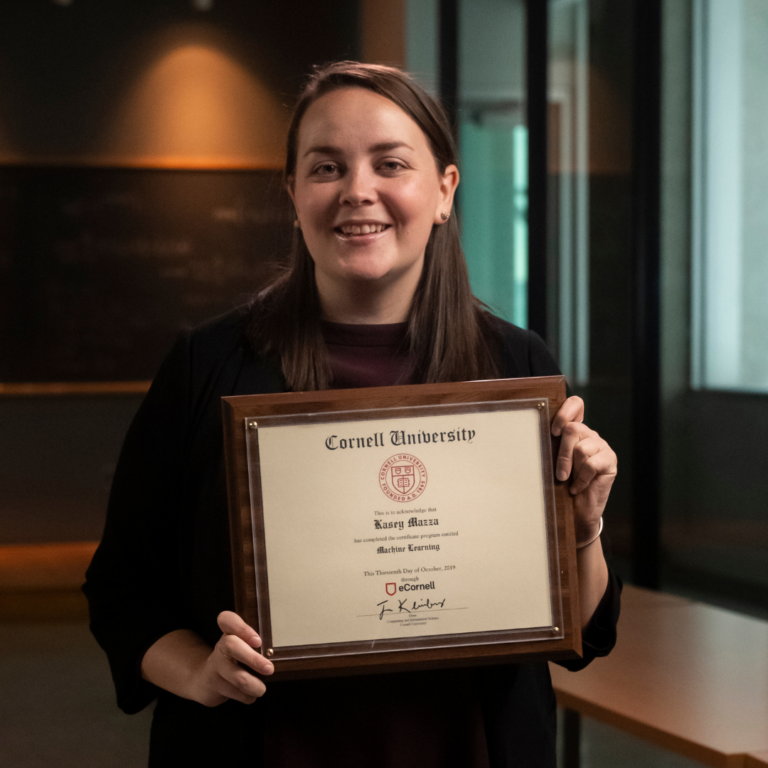
Completing a program from eCornell really has allowed me to think outside the box at work. It gave me the confidence I needed to take a seat at that table and say I am ready.
‐ Kasey M.
Kasey M.

Frequently Asked Questions

Python skills are showing up everywhere, from automating business processes to analyzing data and building the foundations for machine learning and AI. Cornell’s Python Programming Certificate is designed to help you move beyond “knowing syntax” so you can think like a programmer, write code that works, and troubleshoot confidently when it does not.

Across the certificate, authored by faculty from the Cornell Bowers College of Computing and Information Science, you practice the full development loop: You write scripts and user-defined functions, translate English requirements into working code, test and debug systematically, and learn how Python executes in memory so you can fix problems faster. You also build practical, shareable projects that connect Python to real inputs and real data sources, including web services, files, and messy datasets.

You will be most successful if you are ready to practice consistently and do hands-on work on a laptop or desktop, including installing and using a Python code editor. The payoff is a stronger foundation in core programming concepts and the confidence to keep learning independently.

If you want a structured path from fundamentals to real projects, rigorous practice in testing and debugging, and expert guidance in a small, interactive learning environment, you should choose Cornell’s Python Programming Certificate.

Many online Python options stop at watching videos or completing isolated exercises. Cornell’s Python Programming Certificate is built to help you develop the habits of a capable programmer, including precise thinking, disciplined testing, and a clear mental model of what your code is doing while it runs.

You learn through an intentionally interactive experience that blends short instructional videos with frequent coding practice, knowledge checks, and guided projects. Throughout the program, you use development and visualization tools to understand execution step by step then apply that understanding to debugging, writing cleaner functions, and designing programs that meet stated requirements.

The learning model is also more human than a typical self-paced experience. You move through the program with a small cohort, guided by an expert facilitator who supports discussion, answers questions in live sessions, and provides feedback on your work, so you are not learning in isolation as you build real coding confidence.

Enrolling in this certificate also provides you with a 6-month All-Access Pass to eCornell's live online AI Workshops, interactive sessions led by world-class Cornell faculty that combine Ivy League insight with practical applications for busy professionals. Each 3-hour Workshop features structured instruction, guided practice, and real tools to build competitive AI capabilities, plus the opportunity to connect with a global cohort of growth-oriented peers. While AI Workshops are not required, they enhance certificate programs through:

  • Integrating AI perspectives across most curricula
  • Responding to emerging AI developments and trends
  • Offering direct engagement with Cornell faculty at the forefront of AI research

Designed for professionals who want to build real programming capability, Cornell’s Python Programming Certificate fits a wide range of learners, from beginners who want a rigorous start to experienced technical professionals who want stronger fundamentals and better software engineering habits.

The Python Programming Certificate is a strong match if you are:

  • A current or aspiring programmer, software developer, or engineer who wants a structured way to strengthen core Python skills
  • A web developer who wants to add Python scripting and problem solving to your toolkit
  • A computer or data scientist who wants more confidence writing, testing, and debugging code
  • A scientist or technical professional who wants to use Python to automate tasks and work with data

To succeed, you should be comfortable with precalculus and basic algebra, and you should be ready to troubleshoot your computing environment as you work in a Python code editor on a laptop or desktop.

Project work in Cornell’s Python Programming Certificate is designed to pull concepts together into working code you can run, test, and improve. You will complete multiple hands-on coding projects that build from fundamentals to real-world applications, including:

  • Building and running interactive Python scripts that use variables, functions, modules, and user input
  • Writing a set of fully specified functions plus a separate unit test script that verifies behavior and catches edge cases
  • Developing a currency converter that connects to a web service, interprets JSON responses, and provides a simple user-facing script
  • Implementing “challenge” functions that require careful control flow and algorithmic thinking, including string processing and scoring logic
  • Creating a small image-processing application that applies data-structure concepts to real computations
  • Auditing a messy, real-world dataset by reading CSV and JSON files, handling date and time logic, and producing outputs that flag compliance violations

By the end of the program, you will have a portfolio of practical code artifacts that demonstrate core Python programming skills, not just completed quizzes.

Cornell’s Python Programming Certificate helps you build reliable, job-ready programming ability by strengthening how you design, test, debug, and communicate Python code.

After completing the Python Programming Certificate, you will have the skills to:

  • Master programming concepts in Python
  • Use procedural Python statements such as assignments, functional calls, and control structures
  • Organize your code so that you can work in teams
  • Design, code, and test Python functions that meet requirements
  • Visualize, analyze, and debug running Python programs
  • Develop and deploy self-contained Python packages
  • Professionally test and verify your code

Students commonly describe long-term benefits that go beyond finishing assignments. In program feedback, learners emphasize a fast, confidence-building progression from fundamentals to writing real code, with frequent practice through guided projects, interactive exercises, and clear step-by-step instruction. They also highlight practical coverage of core skills such as loops, conditional logic, recursion, debugging, and data validation, plus the flexibility to learn on their own schedule while still moving quickly. Many learners note that facilitator support helps them keep momentum when they get stuck and that the skills feel directly applicable to their work.

What truly sets eCornell apart is how our programs unlock genuine career transformation. Learners earn promotions to senior positions, enjoy meaningful salary growth, build valuable professional networks, and navigate successful career transitions.

Cornell’s Python Programming Certificate, which consists of 6 short courses, is designed to be completed in 5 months. Each course in this certificate runs for 3 weeks, with a typical weekly time commitment of 8 to 12 hours for readings, videos, coding exercises, and project work.

Much of the learning is asynchronous, so you can choose when to complete your work during the week while still benefiting from structure, deadlines, and opportunities to join live sessions with your facilitator and peers.

If you want to move faster, the workload is still realistic as long as you can commit focused time for hands-on coding and debugging on a laptop or desktop.

Students in Cornell’s Python Programming Certificate often describe a fast, confidence-building path from fundamentals to writing real code, with a strong emphasis on practice through guided projects, interactive exercises, and clear, step-by-step instruction.

Learners most frequently highlight:

  • Hands-on Python projects that pull concepts together into a working program
  • Practical coverage of core programming skills such as loops, conditional logic, recursion, debugging, and data validation
  • An interactive coding experience with in-browser tools that let you practice as you learn
  • Short, focused videos that make complex topics easier to absorb
  • Lots of exercises and knowledge checks that reinforce each lesson immediately
  • A structured progression that starts from basics and builds steadily in difficulty
  • The right kind of challenge that pushes you to think critically and research solutions, not just follow templates
  • Flexibility to learn on your own schedule while still moving quickly through the coursework
  • Facilitator support that helps you keep momentum when you get stuck
  • A feeling of real-world applicability, with skills students report using directly in their jobs

Overall, students say the Python Programming Certificate is thorough, well-designed, and engaging, and that the combination of clear teaching and frequent practice helps them finish with a solid foundation and the ability to write Python programs with greater independence.

Instead of focusing solely on syntax, Cornell’s Python Programming Certificate equips you with core programming concepts and professional practices you can reuse in many kinds of work.

You will learn how to:

  • Write and organize scripts and modules, including interactive programs that accept user input
  • Design user-defined functions with clear specifications, including preconditions and informative error messages
  • Test code systematically with scripted unit tests and better test-case design
  • Debug efficiently by interpreting stack traces, tracing execution, and visualizing memory and call frames
  • Use control structures such as conditionals, for-loops, while-loops, try-except blocks, and recursion to solve problems cleanly
  • Work confidently with common Python data structures, including lists and dictionaries, and understand how mutability and references affect your code

These skills make your code easier to read, easier to verify, and easier to maintain as projects grow.

Real work rarely hands you perfectly formatted inputs, so Cornell’s Python Programming Certificate includes projects that require you to pull and process external data.

You will have the opportunity to:

  • Connect a Python program to a web service using an API-style request and interpret JSON responses, including error conditions
  • Read and write common data formats such as plain text, CSV, and JSON using Python’s standard libraries
  • Create, parse, compare, and format dates and times, including working with time zones when needed

This experience helps you move from writing standalone code to building practical scripts and small applications that interact with the kinds of data organizations use every day.

A willingness to practice and troubleshoot will take you far in Cornell’s Python Programming Certificate. You do not need a computer science degree to begin, but you will be most successful if you are comfortable with precalculus and basic algebra.

You will also use a practical toolset that mirrors how Python is commonly learned and used:

  • A Python code editor on your computer
  • A browser-based coding environment for hands-on exercises and submissions
  • Visualization tools that help you step through code execution while debugging

Because the work is coding intensive, you should plan to complete coursework on a laptop or desktop computer rather than a phone or tablet.