Course list

This course provides an introduction to the programming environment and explores the basics of Python. After learning how to run a script, you will work with Python expressions, functions, and variables in interactive mode. By the end of the course, you will be able to write a basic Python script that includes built-in functions and modules.
  • Apr 29, 2026
  • May 20, 2026
  • Jun 10, 2026
  • Jul 1, 2026
  • Jul 22, 2026
  • Aug 12, 2026
  • Sep 2, 2026

This course explores Python functions. As you expand your technical vocabulary, you will practice visualizing Python executions. In addition, you will examine the rules for writing functions and recognize a properly formatted specification. You will explore writing simple functions to process text and be able to turn an English description into code. You will also practice testing and debugging code and learn how to interpret error messages.

The following course is required to be completed before taking this course:

  • Python Fundamentals
  • Apr 29, 2026
  • May 20, 2026
  • Jun 10, 2026
  • Jul 1, 2026
  • Jul 22, 2026
  • Aug 12, 2026
  • Sep 2, 2026

This course shows you how to move beyond straight line code and write programs that require complex decisions. These might occur within a business workflow or a complex scientific computation. You will write conditional, try-except, for-loop, and while-loop statements, as well as use them to design functions. 

The following courses are required to be completed before taking this course:

  • Python Fundamentals
  • User-Defined Functions in Python
  • Developing a Currency Converter
  • Apr 29, 2026
  • May 6, 2026
  • May 20, 2026
  • May 27, 2026
  • Jun 10, 2026
  • Jun 17, 2026
  • Jul 1, 2026

This course introduces you to mutable data structures, which are advanced Python types that enable faster updating and search than basic types like ints and strings. These types are necessary for working with large data sets but can be difficult to master. You will explore multiple methods to work with these objects, which include lists, sets, and dictionaries. You will also write expressions and employ extensive use of visualization.

The following courses are required to be completed before taking this course:

  • Python Fundamentals
  • User-Defined Functions in Python
  • Developing a Currency Converter
  • Controlling Program Flow
  • Apr 29, 2026
  • May 20, 2026
  • Jun 10, 2026
  • Jul 1, 2026
  • Jul 22, 2026
  • Aug 12, 2026
  • Sep 2, 2026

You will begin by examining several types of files and objects. You will then apply the concepts you have learned in the previous courses to solve a real-world business problem: auditing an organization's regulatory compliance. Working with heterogeneous data, you will first read a series of disparate data files and determine how to integrate the data. You will then write a sequence of scripts that pull information from these files and inform the user on whether the organization has fully complied with regulations.

This course serves as a capstone experience to five courses:

  • Python Fundamentals
  • User-Defined Functions in Python
  • Developing a Currency Converter
  • Controlling Program Flow
  • Mastering Data Structures
  • Apr 29, 2026
  • May 20, 2026
  • Jun 10, 2026
  • Jul 1, 2026
  • Jul 22, 2026
  • Aug 12, 2026
  • Sep 2, 2026

Python is much more than a programming language. In this course, you will leverage the comprehensive Python ecosystem of libraries, frameworks, and tools to develop complex data science applications. Throughout this course, you will practice using the different Python tools appropriate to your dataset. You will leverage library resources for data acquisition and analysis as well as machine learning. Dataframes will be introduced as a means of manipulating structured data tables for advanced analysis. Additionally, you will practice basic routines for data visualization utilizing Jupyter Notebooks.

You are required to have completed the following courses or have equivalent experience before taking this course:

  • Constructing Expressions in Python
  • Writing Custom Python Functions, Classes, and Workflows
  • Apr 22, 2026
  • May 20, 2026
  • Jun 17, 2026
  • Jul 15, 2026
  • Aug 12, 2026
  • Sep 9, 2026
  • Oct 7, 2026

Decision-makers generally do not use raw data to make decisions; they prefer data be summarized in easily understood formats that facilitate efficient decision-making. This course introduces data manipulation and visualization, both critical components of any data science project. This course introduces two commonly used data manipulation tools in the Python ecosystem: NumPy and Pandas. In addition, the Python ecosystem also includes a variety of data plotting packages such as Matplotlib, Seaborn, and Bokeh — each of which specialize in particular aspects of data visualization. This course will give you experience integrating NumPy, Pandas, and the plotting packages to create rich, interactive data visualizations that help drive efficient decision-making.

You are required to have completed the following courses or have equivalent experience before taking this course:

  • Constructing Expressions in Python
  • Writing Custom Python Functions, Classes, and Workflows
  • Developing Data Science Applications
  • May 13, 2026
  • Jun 10, 2026
  • Jul 8, 2026
  • Aug 5, 2026
  • Sep 2, 2026
  • Sep 30, 2026
  • Oct 28, 2026

Most data science projects that use Python will require you to access and integrate different types of data from a variety of external sources. This course will give you experience identifying and integrating data from spreadsheets, text files, websites, and databases. To prepare for downstream analyses, you first need to integrate any external data sources into your Python program. You will utilize existing packages and develop your own code to read data from a variety of sources. You will also practice using Python to prepare disorganized, unstructured, or unwieldy datasets for analysis by other stakeholders.

You are required to have completed the following courses or have equivalent experience before taking this course:

  • Constructing Expressions in Python
  • Writing Custom Python Functions, Classes, and Workflows
  • Developing Data Science Applications
  • Creating Data Arrays and Tables in Python
  • May 6, 2026
  • Jun 3, 2026
  • Jul 1, 2026
  • Jul 29, 2026
  • Aug 26, 2026
  • Sep 23, 2026
  • Oct 21, 2026

In order to be useful within a professional environment, data must be structured in a way that can be understood and applied to real-world scenarios. This course introduces using Python to perform statistical data analysis and create visualizations that uncover patterns in your data. Using the tools and workflows you developed in earlier courses, you will carry out analyses on real-world datasets to become familiar with recognizing and utilizing patterns. Finally, you will form and test hypotheses about your data which will become the foundation upon which data-driven decision-making is built.

You are required to have completed the following courses or have equivalent experience before taking this course:

  • Constructing Expressions in Python
  • Writing Custom Python Functions, Classes, and Workflows
  • Developing Data Science Applications
  • Creating Data Arrays and Tables in Python
  • Organizing Data with Python
  • Apr 29, 2026
  • May 27, 2026
  • Jun 24, 2026
  • Jul 22, 2026
  • Aug 19, 2026
  • Sep 16, 2026
  • Oct 14, 2026

In this course, you will explore some of the machine learning tools you can use to magnify the analytical power of Python data science programs. You will use the scikit-learn package — a Python package developed for machine learning applications — to develop predictive machine learning models. You will then practice using these models to discover new relationships and patterns in your data. These capabilities allow you to unlock additional value in your data that will aid in making predictions and, in some cases, creating new data.

You are required to have completed the following courses or have equivalent experience before taking this course:

  • Constructing Expressions in Python
  • Writing Custom Python Functions, Classes, and Workflows
  • Developing Data Science Applications
  • Creating Data Arrays and Tables in Python
  • Organizing Data with Python
  • Analyzing and Visualizing Data with Python
  • Apr 22, 2026
  • May 20, 2026
  • Jun 17, 2026
  • Jul 15, 2026
  • Aug 12, 2026
  • Sep 9, 2026
  • Oct 7, 2026

Databases power things that we rely on every day of our lives, from displaying restaurant menus to processing payments to tracking likes and comments. These tasks require you to work with much more data than you may be used to, as real-life data sets can be extremely large and cumbersome. Using a database to organize your data allows you to work with it systematically and at scale.

This course provides you with the foundational knowledge for integrating databases into your programs and using them to read, write, store, and process data. You will cover the basics of working with files and complex data structures. You will explore important data formats like JSON and CSV, discover how to write database queries that extract information of interest from a database, and get an introduction to the SQL database programming language. With these new tools, you will be able to work with huge amounts of data that would otherwise be tedious and time consuming to process manually.

You are required to have completed the following courses or have equivalent experience before taking this course:

  • How to Write Programs That Make Choices With Control Flow
  • How to Write Functions to Automate Repetitive Tasks
  • Jun 17, 2026
  • Sep 9, 2026
  • Dec 2, 2026
  • Feb 24, 2027
  • May 19, 2027

In this course, you will begin to work with web services and applications that allow you to complete certain tasks online. As part of your coursework, you will write a program that connects and pulls data from the web. Expanding upon this, you will then scale your data collection to get large amounts of data in the form of a database, and you will use the data you collect to create your own web service. You will be introduced to a web framework called Flask that utilizes prepackaged HTML templates to allow you to systematically set up and operate your web service, enabling others to interact with your content.

The following course is required to be completed before taking this course:

  • How to Write Programs That Work With Databases

Additionally, you are required to have completed the following courses or have equivalent experience:

  • How to Write Programs That Make Choices With Control Flow
  • How to Write Functions to Automate Repetitive Tasks
  • Jul 1, 2026
  • Sep 23, 2026
  • Dec 16, 2026
  • Mar 10, 2027
  • Jun 2, 2027

With the introduction of three more programming languages in this course, you will create interactive web applications that let users do things in their browsers, such as upload photos or play simple games. Using HTML, you can create the basic framework of a website, write CSS to decorate and style the site, and then see how JavaScript can be used to add engaging interactive elements. You will also get a chance to automate the HTML writing by using the Flask framework to more easily produce web page structures, allowing you to connect your apps to a database to generate bulk HTML content programmatically.

The following courses are required to be completed before taking this course:

  • How to Write Programs That Work With Databases
  • How to Develop Web Interfaces With Online Protocols

Additionally, you are required to have completed the following courses or have equivalent experience:

  • How to Write Programs That Make Choices With Control Flow
  • How to Write Functions to Automate Repetitive Tasks
  • Apr 22, 2026
  • Jul 15, 2026
  • Oct 7, 2026
  • Dec 30, 2026
  • Mar 24, 2027
  • Jun 16, 2027

eCornell Online Workshops are live, interactive 3-hour learning experiences led by Cornell faculty experts. These premium short-format sessions focus on AI topics and are designed for busy professionals who want to gain immediately applicable skills and strategic perspectives. Workshops include faculty presentations, breakout discussions, and guided hands-on practice.

The AI Workshops All-Access Pass provides you with unlimited participation for 6 months from your date of purchase. Whether you choose to attend one workshop per month, or several per week, the All-Access Pass will allow you to customize your AI journey and stay on top of the latest AI trends.

Workshops cover a range of cutting-edge AI topics applicable across industries, hosted by Cornell faculty at the forefront of their fields. Whether you are just getting started with AI, seeking to build your AI skillset, or exploring advanced applications of AI, Workshops will provide you with an action-oriented learning experience for immediate application in your career. Sample Workshops include:

  • Work Smarter with AI Agents: Individual and Team Effectiveness
  • Leading AI Transformation: Bigger Than You Imagine, Harder Than You Expect
  • Using AI at Work: Practical Choices and Better Results
  • Search & Discoverability in the Era of AI
  • Don't Just Prompt AI - Govern it
  • AI-Powered Product Manager
  • Leverage AI and Human Connection to Lead through Uncertainty

Human-computer interfaces have become a part of everyday life, whether we consider technology that we use at home or at work. People rely on technology to help them achieve a goal or solve a problem, and this idea is central to the emerging and rapidly expanding field of human-centered design: Who is using the interface, and for what purpose? How can we help them do that better? Answering these questions should be at the heart of the design process, as technologies are ultimately for people to use, and designers need to make this as intuitive and smooth as possible.

Design doesn't happen in a lab; it happens in the world, and gathering information about the users of your product ensures better design. In this course, you will be introduced to human-computer interaction design, use practical methods for applying sound design principles, and execute the entire process. You'll discover the basics of how to identify a human need, how and why you need to keep that need at the center of the design process, uncover what can be measured to improve the design, and ensure that you conduct your research fairly and ethically.

  • May 6, 2026
  • Jun 3, 2026
  • Jul 1, 2026
  • Jul 29, 2026
  • Aug 26, 2026
  • Sep 23, 2026
  • Oct 21, 2026

When giving a presentation, you want to ensure you communicate all of your critical ideas while you have your audience's attention. There are more effective ways of doing so beyond the standard large amounts of text and bullet points.

In this course, you will have the opportunity to rethink the way you design your presentations and slides. You will discover that there are straightforward ways to use your slide decks to serve two purposes: support your technical and business presentations while making your slide decks reusable and valuable resources inside your organization. You will then examine the life cycle of your presentations and begin to document who uses your slides, when they are used, and what clearances are needed to share and use them. You will also consider legal issues or proprietary concerns that may exist. Finally, you will start to build a process to help you protect proprietary information before you share it with external parties. As part of your study, you will review various selections from Dr. Traci Nathans-Kelly's book “Slide Rules,” which provides helpful insights and enlightening examples that you can apply in your own presentations.

You will be required to purchase Traci Nathans-Kelly's book “Slide Rules” to complete your coursework.

You are required to have completed the following course or have equivalent experience before taking this course:

  • Redesigning Slides for Impact
  • Engaging Presentation Techniques
  • Jul 1, 2026
  • Oct 21, 2026
  • Feb 10, 2027
  • Jun 2, 2027

Since the advent of presentation software like PowerPoint, presenters have been led astray by the design of slide templates. The software applications were originally created to help presenters outline their talks, but the slideware's design did not account for the needs of audiences nor factor in cognitive research. As a consequence, the templates have ingrained poor presentation habits that often confuse and disengage the people who are meant to benefit from these talks.

In this course you will have an opportunity to begin challenging the norm and break this cycle of "slide deck drudgery." By replacing old presentation habits with new best practices that you gain from this course, you can shift your focus to the needs and interests of your audience, and you can begin to use your slides to communicate your ideas more clearly and effectively. You will explore new techniques that will help you to improve the flow of your talk and keep your audience focused on your main ideas. You will then study effective presentation design and development practices as you read various selections from Dr. Traci Nathans-Kelly's book “Slide Rules,” which contains valuable insights and examples that you can apply in your own presentations.

You will be required to purchase Traci Nathans-Kelly's book “Slide Rules” to complete your coursework.

You are required to have completed the following course or have equivalent experience before taking this course:

  • Redesigning Slides for Impact
  • Jun 17, 2026
  • Oct 7, 2026
  • Jan 27, 2027
  • May 19, 2027
This course aims to make statistical analysis approachable and practical, as you learn how to read and interpret statistical reports in a business environment, and how to communicate statistical results to stakeholders. First, you will practice assessing the statistical components and representations of statistical results in a case study. You will then identify the appropriate method and conduct a summary analysis of a data set. Finally, you will prepare an executive summary of the key statistical points identified through your analysis and create a narrative summary with supporting graphics.
  • Jul 1, 2026
  • Aug 12, 2026
  • Nov 4, 2026
  • Jan 27, 2027
  • Apr 21, 2027

In this course, you will practice making informed decisions based on statistical results. You will be introduced to the techniques you will use to view statistical tests critically and recognize the limitations of statistical conclusions. Next, you will examine statistical reports in order to identify the underlying research question. You will then use these insights to compare tests and rate their validity. Finally, you will prepare a report for stakeholders, providing recommendations based on your interpretation of statistical results.

You are required to have completed the following course or have equivalent experience before taking this course:

  • Interpreting and Communicating Data
  • Jun 3, 2026
  • Jul 15, 2026
  • Aug 26, 2026
  • Nov 18, 2026
  • Feb 10, 2027
  • May 5, 2027

Request
more Info
by completing the form below.

Act today—courses are filling fast.

How It Works

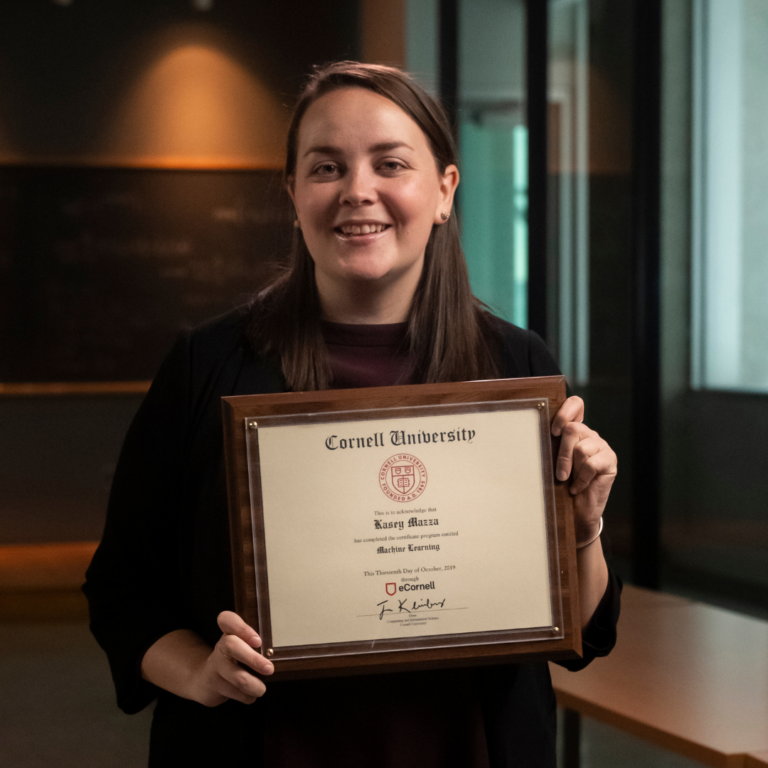
Completing a program from eCornell really has allowed me to think outside the box at work. It gave me the confidence I needed to take a seat at that table and say I am ready.
‐ Kasey M.
Kasey M.

Frequently Asked Questions

Python shows up everywhere, from automating everyday business tasks to powering modern data analytics and machine learning. Cornell’s Python 360 Certificate helps you build real fluency with the language, then extend that foundation into the tools and workflows professionals use to work with data, validate results, and turn code into something other people can run and use.

Across this certificate program from the Cornell Bowers College of Computing and Information Science, you will move beyond isolated syntax practice and learn how to think like a programmer: breaking problems down, writing and testing functions against clear specifications, debugging with purpose, and working confidently with data structures and real files. As you progress, you’ll also practice modern data science workflows in Python, including working in notebook environments, organizing and cleaning datasets, visualizing results, and using common machine learning tools to explore patterns.

If you want practical Python skills you can apply immediately, confidence built through hands-on coding and feedback, and an end-to-end pathway from programming fundamentals to real data work, you should choose Cornell’s Python 360 Certificate.

Many online Python offerings either stay at the level of short videos and auto-graded drills or assume you can teach yourself the hard parts of debugging and program design. Cornell’s Python 360 Certificate is built to help you develop working competence by practicing the full workflow: write code, test it, interpret errors, debug systematically, and improve your solution until it meets clear requirements.

You learn in an expert-facilitated, cohort-based environment where discussion and live touchpoints help you apply concepts, and where project work is reviewed with feedback rather than left entirely to automated scoring. The Python 360 Certificate curriculum is designed by Cornell faculty, and the learning experience emphasizes applied, competency-based work that mirrors what you do in real roles, such as building multi-file programs, working with structured data formats like CSV and JSON, handling dates and times, and using notebook-based workflows for analysis and visualization.

The result is a program that builds from core programming skills into data-focused capabilities while still staying grounded in the habits that make code reliable: specifications, testing, and debugging.

Enrolling in Cornell’s Python 360 Certificate also provides you with a 6-month All-Access Pass to eCornell's live online AI Workshops, interactive sessions led by world-class Cornell faculty that combine Ivy League insight with practical applications for busy professionals. Each 3-hour Workshop features structured instruction, guided practice, and real tools to build competitive AI capabilities, plus the opportunity to connect with a global cohort of growth-oriented peers. While AI Workshops are not required, they enhance certificate programs through:

  • Integrating AI perspectives across most curricula
  • Responding to emerging AI developments and trends
  • Offering direct engagement with Cornell faculty at the forefront of AI research

Cornell’s Python 360 Certificate is designed for professionals who want a structured, hands-on way to build real Python capability and then apply it to common technical work, especially data-focused tasks.

The Python 360 Certificate program is a strong fit if you:

  • Want to build or strengthen programming fundamentals, including writing scripts and functions, reading documentation, and debugging effectively
  • Need practical skills for working with data and files, including structured formats like CSV and JSON and real-world date and time handling
  • Work in roles that benefit from analysis and automation, such as data analysis, business analysis, technical systems work, software development, or technical leadership
  • Prefer a guided learning experience with facilitator support, deadlines, and peer learning rather than learning entirely alone

To be ready for the pace and problem solving, you should be comfortable with pre-calculus, basic algebra, and tinkering with your computer on a laptop or desktop setup.

Project work in Cornell’s Python 360 Certificate is designed to help you practice the same steps you use in real programming and data work: Write code from a requirement, test it, debug it, and iterate until it works reliably.

Examples of the types of projects you will complete include:

  • Building interactive scripts that take user input and produce correct output, then using visualization tools to step through execution and debug
  • Writing your own reusable functions from English requirements, adding clear specifications and preconditions, and creating unit tests to validate behavior
  • Implementing programs that make decisions and repeat actions using conditionals, try-except error handling, and loop patterns
  • Working with core data structures such as lists, nested lists, and dictionaries to represent and process multidimensional or structured information
  • Reading and writing real-world data files, including CSV and JSON, and handling datetime and time zone details to support accurate analysis
  • Completing a capstone-style auditing application that integrates multiple datasets and flags compliance issues by applying rules to messy, heterogeneous data
  • Developing notebook-based analyses that combine code, narrative, and visualizations using widely used Python libraries
  • Training and assessing basic predictive models with scikit-learn, including supervised prediction and unsupervised clustering on real datasets

Cornell's Python 360 Certificate helps you build credible, job-ready Python capability by strengthening how you design, test, debug, and apply programs to real data problems.

After completing the Python 360 Certificate, you will be prepared to:

  • Master the foundational concepts of programming in Python
  • Design, code, and test Python functions that meet requirements
  • Write custom functions and data classes in Python that can be stored for reuse
  • Visualize, analyze, and debug running Python programs
  • Use Jupyter Notebooks to integrate data analysis, visualization, and documentation
  • Filter, integrate, and prepare data for analysis
  • Employ coding best practices using the Matplotlib framework, Pandas, and NumPy
  • Explore datasets with machine learning
  • Relate concepts in human attention and perception to best practices in visualization
  • Apply and interpret real-world data in statistical models to make predictions about new situations
  • Write programs that connect to the web to download data and use web services
  • Write a basic web-based application

Students commonly describe the program as confidence-building and immediately practical, especially for translating learning into real work while balancing a full-time schedule. Feedback highlights frequent hands-on coding, practice with real datasets (including structured files like CSV and Excel-style tables), and job-relevant work in data wrangling, validation, and debugging. Learners also point to early, clear exposure to widely used Python tools such as NumPy and pandas, visualization foundations with tools like Matplotlib and Seaborn, and an applied introduction to machine learning concepts using scikit-learn. Many describe the experience as moving them beyond theory into doing, whether that means writing working programs, automating tasks, or building a foundation for analytics and machine learning projects.

What truly sets eCornell apart is how our programs unlock genuine career transformation. Learners earn promotions to senior positions, enjoy meaningful salary growth, build valuable professional networks, and navigate successful career transitions.

Cornell’s Python 360 Certificate, which consists of 15 short courses (13 core and 2 elective), is designed to be completed in 10 months. Each course runs for 2 weeks, with a typical weekly time commitment ranging from 3 to 12 hours

In practice, you can expect a mix of flexible, asynchronous learning and structured deadlines to help you keep momentum. Much of your time goes into hands-on coding exercises and projects, so many learners plan consistent weekly blocks to code, troubleshoot, and revise their work.

Because this program includes programming assignments, you should plan to do your work on a laptop or desktop computer rather than a mobile device, and be ready to install and use a Python environment and tools introduced during the program.

Students in Cornell's Python 360 Certificate consistently describe it as a practical, confidence-building way to develop real Python skills while balancing a full-time job. They often highlight how the program moves from fundamentals to applied data work, with hands-on coding that mirrors workplace tasks and reinforces learning through frequent practice.

Learners commonly point to outcomes and experiences like these:

  • Strong hands-on coding in an in-browser lab environment (including Jupyter-style notebooks)
  • Meaningful practice with real datasets like CSV and Excel files
  • Job-relevant work in data wrangling, validation, and debugging
  • Early exposure to core Python data libraries such as NumPy and pandas
  • Clear introductions to visualization tools like Matplotlib and Seaborn
  • Applied foundations in machine learning concepts using scikit-learn
  • Capstone-style projects that bring multiple skills together in a realistic workflow
  • Step-by-step lessons that help beginners build confidence quickly
  • Short, digestible lessons that make it easier to study in small time blocks
  • A consistent mix of videos, readings, quizzes, and coding exercises
  • Useful facilitator support with actionable feedback
  • Flexible pacing with structure that helps working professionals stay on track
  • Clear organization that makes it easy to see progress and next steps

Overall, students say Cornell’s Python 360 Certificate helps them move beyond theory into doing, whether that means writing their first working programs, automating everyday tasks, or building a foundation for data analytics and machine learning projects they can apply immediately on the job.

Prior professional programming experience is not required, but you will get the most value from Cornell’s Python 360 Certificate if you come in ready to learn technical material and practice regularly.

You should be comfortable with:

  • Pre-calculus and basic algebra
  • Working on a computer and being willing to troubleshoot setup steps, such as installing and using a Python environment

The early part of Cornell's Python 360 Certificate program is designed to build a foundation in how Python runs, how to write basic scripts, and how to think about variables, functions, and debugging. As the program progresses, you will use those fundamentals to work with larger programs, data structures, data files, notebooks, and common data science tools.

Cornell’s Python 360 Certificate is designed to help you practice Python the way it is used in modern work settings, which includes working in coding environments that support data exploration and using widely adopted libraries.

You will gain experience with:

  • Jupyter Notebooks as a workflow for combining analysis, visualizations, and documentation in a single shareable format
  • Core data science libraries including NumPy and Pandas for arrays and tabular data
  • Common visualization tools such as Matplotlib and Seaborn, with exposure to interactive visualization concepts
  • Scikit-learn for training and evaluating machine learning models, including both prediction and clustering

You will also practice working with common data formats such as CSV and JSON, which are frequently used for exchanging data across systems.

Cornell’s Python 360 Certificate includes hands-on exposure to machine learning concepts and workflows using Python, with an emphasis on understanding problem types and practicing model-building with real datasets.

You will be prepared to:

  • Distinguish common machine learning problem types such as supervised prediction and unsupervised clustering
  • Train, test, and evaluate models using scikit-learn in a notebook environment
  • Use machine learning as a way to explore patterns and relationships in data, alongside more traditional analysis and visualization

Machine learning work is practice-oriented and builds on earlier skills you develop in organizing data, working with tables, and interpreting results.