Scroll through LinkedIn and you’ll find plenty of posts celebrating a new certificate or credential. Yet a look beyond the announcement often reveals that learners have more to say about the experience itself.
In reflections shared by eCornell learners, the credential is usually only part of the story. They write about applying new approaches at work, asking better questions, gaining confidence in unfamiliar areas, and discovering where they want to grow next.
Their experiences span healthcare, technology, finance, marketing, entrepreneurship, and leadership. While the goals and programs vary, these reflections offer a closer look at what continuous learning can mean for working professionals.
Learning That Changes the Way You Work
For many learners, the value of professional education becomes apparent when they return to the work they’re already doing but see it from a new perspective.
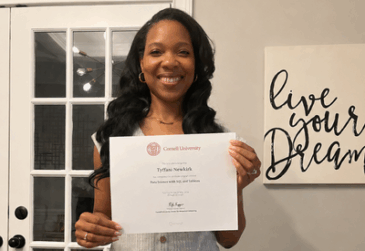
After completing Cornell’s Data Science With SQL and Tableau Certificate, business analyst Tyffani Newkirk reflected on a change in the way she approaches data:
“What really shifted for me was this: I’m not just pulling data anymore. I’m thinking through what it means, what’s changing, and how it should guide a decision.”
Tyffani shared that she was already putting that perspective into practice in her business analyst role, in her work translating financial information into board-level insights as Treasurer for The WICT Network: Carolinas, and in her ongoing work building her Tableau portfolio.
Healthcare leader Angelina Willett described a similar connection between learning and her current work after completing Cornell’s Data Analytics Certificate:
“Healthcare leaders are surrounded by data, but the real challenge is translating that information into meaningful insights that drive better decisions, improve access to care, and strengthen outcomes for the patients and families we serve.”
For both learners, completing a certificate wasn’t separate from their professional responsibilities; it gave them new ways to approach work they were already doing.
Sometimes Learning Becomes Relevant in Unexpected Ways
Not every learner begins a program knowing exactly how it will shape their career.
When Pawel Szczygielski enrolled in a startup finance course, a new career path was the last thing on his mind. That shift gave the learning immediate relevance.
“When I first signed up for the Startup Funding and Finance certificate, I had no idea I would leave the corporate world and join a startup. Instead, I just wanted to use my development budget on something interesting and ‘fun.’ And this course has given me much more: knowledge and awareness directly applicable to my current job.”
Rather than emphasizing ready-made solutions, Pawel reflected on the questions the experience helped him ask about board reporting, future capital raises, and compensation.
His experience illustrates one reason professionals continue learning even without a clear career goal in mind: New knowledge can become useful in ways they couldn’t predict when they started.
Better Questions Can Be as Valuable as New Answers
That theme also appears in learners’ reflections on artificial intelligence.
After earning Cornell’s AI Strategy Certificate, technology strategy leader Yachna Rotwal shared her key insight:
“My biggest takeaway: AI strategy is not about tools. It is about making better decisions on where to invest, how to validate assumptions early, and how to balance protecting current operations with building for the future.”
Yachna’s reflection focuses less on mastering a particular technology than on developing a framework for thinking about it.
That distinction matters in a field changing as quickly as AI. For Yachna, the experience provided a way to think more strategically about the decisions surrounding the technology and how she might put that thinking into practice.
The Process Can Matter as Much as the Credential
Other learners describe the work of earning the certificate itself as an important part of the experience.
Product and design leader Sonali Agrawal reflected on the late nights she spent completing Cornell’s Performance Leadership Certificate while continuing to work. For her, the value came from being asked to examine her own leadership rather than simply read about it.
“Honestly, the real story isn’t the certificate. It’s the process.”
She described working through projects focused on credibility, decision making, cross-cultural dynamics and team health, including moments when course exercises prompted her to reconsider her own approach:
“It’s one thing to nod along to a framework. It’s another thing entirely when the exercise asks you to apply it to a real situation and you realize…’oh, I could do this better.’”
Sonali’s reflection captures an aspect of professional education that a credential alone can’t show: the real work of examining established habits and considering how new ideas apply to real situations.
Learning Can Help Bridge the Gap Between Experience and Understanding
For professionals who already have significant experience, continued education can also provide another way of understanding work they know well.
Mannav Shah, a contract management leader in the public sector, pursued Cornell’s Business Contracts credential to deepen his legal understanding of work he encounters every day.
“I entered the programme confident in my experience but left with greater knowledge, a distinction worth pursuing.”
He described the program as helping bridge a gap between contract management and legal understanding, with particular relevance to areas including risk management, negotiation, and enforcing contract terms.
Rather than replacing professional experience, Mannav’s learning gave him another perspective from which to approach it.
New Knowledge Can Open the Door to What Comes Next
For some learners, completing a program marks the beginning of a new professional goal.
Gabriela Tejada, founder of Cafecito Social, came to Cornell’s Food Product Development Certificate with experience building a brand but a new challenge ahead: turning a café recipe into a shelf-stable product.
As she put it:
“When I opened Cafecito Social, I knew how to build a brand. Everything else I’ve been kind of winging. But taking a café recipe and turning it into a shelf-stable product is a completely different ball game. Formulation, processing, food safety, packaging, co-packer relationships. That wasn’t something I could just figure out as I went.”
Her response was straightforward:
“So I went and learned it.”
Gabriela is now looking toward bringing her Guatemalan-roasted coffee to retail shelves. In her case, learning became one piece of a larger entrepreneurial journey, helping her build knowledge in an area that was new to her while drawing on the experience she already had.
Beyond the Certificate
There is no single reason professionals pursue continuing education, and there is no single measure of what makes the experience valuable.
For Tyffani, learning changed how she approaches data. Angelina connected analytics more closely to the healthcare outcomes she cares about. Pawel found that learning he initially pursued out of curiosity became directly relevant to an unexpected career move. Yachna came away with a framework for thinking strategically about AI. Sonali used the experience to examine how she leads, while Mannav and Gabriela built knowledge that complemented experience they already had.
Their stories also show why the credential itself rarely tells the whole story. A certificate marks an accomplishment, but what learners do with the experience afterward can take many different forms: applying a new approach, asking a better question, tackling an unfamiliar challenge, or deciding what they want to learn next.
For working professionals, continuous learning doesn’t always mean preparing for an entirely different future. Sometimes, it means seeing new possibilities in the work already in front of them.
Sharing the Achievement
For learners who choose to share their accomplishments, eligible Cornell certificate programs now include a Cornell University Digital Credential. The secure, verified credential documents the certificate program completed along with the skills, competencies, and learning outcomes associated with the program.
Learners can share their Digital Credential on LinkedIn, résumés, professional portfolios, personal websites, and other professional channels.
But as the reflections above show, what learners choose to share often goes beyond the credential itself. Their posts tell the story behind the achievement: the work they put in, what they learned, how they’re applying it, and where they hope to go next.
Explore Cornell Digital Credentials →