Career development doesn’t always mean preparing for a different job.
Sometimes, growth begins with recognizing that the work in front of you requires knowledge you don’t have yet.
A marketer may need to understand the business or industry behind what she’s marketing. A finance professional may need greater insight into the operational decisions behind the numbers. An entrepreneur may discover that building the next stage of a business requires technical expertise far outside the skills that helped launch it.
For three Cornell certificate program learners, professional development meant looking beyond the boundaries of their existing roles. Their reasons for enrolling were different, but their experiences share a common thread: Learning in an adjacent discipline gave them new ways to approach challenges already emerging in their work.
From Building a Brand to Building a Product
When Gabriela Tejada opened Cafecito Social, she brought experience in building a brand. But as she began thinking about taking the company’s coffee beyond the café and onto retail shelves, Gabriela encountered an entirely different set of questions.
Turning a café recipe into a shelf-stable product required knowledge of formulation, processing, food safety, packaging, and co-packer relationships. Those weren’t extensions of branding expertise; they were a new discipline.
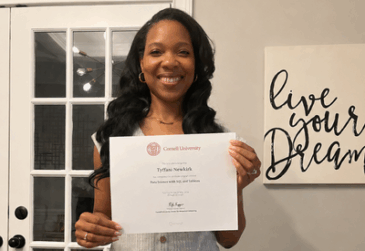
Gabriela decided to close that gap, completing Cornell’s Food Product Development Certificate through eCornell with support from Cornell AgriTech’s Food Spark program.
As she described it:
“When I opened Cafecito Social, I knew how to build a brand. Everything else I’ve been kind of winging. But taking a café recipe and turning it into a shelf-stable product is a completely different ball game. Formulation, processing, food safety, packaging, co-packer relationships. That wasn’t something I could just figure out as I went.”
Gabriela’s next sentence captures the decision at the heart of her story:
“So I went and learned it.”
For Gabriela, the certificate became part of a larger effort to prepare Cafecito Social for its next chapter. The company currently serves coffee roasted at origin in Guatemala, and she is working toward bringing that coffee to retail shelves. She described the certificate as providing the technical foundation for that goal.
Gabriela’s experience shows how professional development can become especially relevant when a new business challenge stretches beyond the expertise that got you there.
Understanding the Work Behind the Story
Kali Hammond approached cross-disciplinary learning from a different direction.
Working in legal marketing and business development, Kali wasn’t looking to become an attorney. She wanted to better understand the work her attorneys do and the challenges their clients face.
That motivation led her to complete Cornell’s Business of Law Certificate.
Kali explained her reason for pursuing the program this way:
“The best way to tell our clients’ stories is to first understand the work behind them.”
Through the program, Kali developed a deeper understanding of business law fundamentals, contracts, legal practice areas, and the business and legal considerations that influence client decisions. She connected that knowledge directly to her responsibilities in marketing and business development.
“While I’m not an attorney, the experience gave me valuable perspective on the work behind the services we market and the challenges our clients face.”
For Kali, learning outside her primary discipline wasn’t about changing professions but about understanding her own work in a broader context.
As she reflected:
“In legal marketing and business development, the more we understand our clients’ businesses and our attorneys’ work, the better we can create meaningful thought leadership, support strategic growth, and communicate the value our firms deliver.”
Kali’s experience offers another way to think about professional development: The most useful next skill isn’t always one that deepens your existing specialty. Sometimes it’s one that helps you better understand the people, decisions, or industries surrounding it.
Looking Beyond the Numbers
For Heinrich Azpeytia, curiosity grew out of the conversations happening around his work.
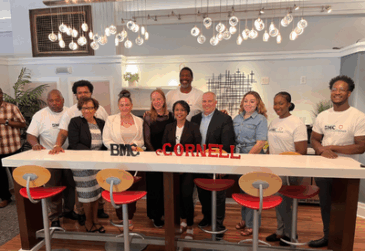
Heinrich had spent several years gaining exposure to the hotel industry, most notably in his role at Amstar DMC. There, he worked closely with asset managers and general managers, developing a greater appreciation for the reasoning behind the financial decisions he encountered.
As Heinrich put it:
“Coming from a finance and analytics background, I’ve always been drawn to understanding how value is created…especially in complex, relationship-driven industries.”
His interest led him to complete Cornell’s Hotel Real Estate Investments and Asset Management credential. The learning helped him align his numbers-driven experience with the thinking of hotel leaders balancing guest experience, agreements, and long-term asset performance.
Heinrich reflected:
“This program has helped me better connect those perspectives with my role, reinforcing the importance of alignment and empathy when structuring agreements.”
For Heinrich, expanding his knowledge gave him another lens through which to use his established expertise. He plans to continue applying those insights in his work at Amstar and within Hyatt, particularly as he supports initiatives involving multiple stakeholders and long-term value.
Your Next Skill May Be Adjacent to the One You Already Have
Gabriela, Kali, and Heinrich work in very different fields. One is building a consumer brand, one works in legal marketing and business development, and a one comes from a background in finance and analytics.
None of them pursued professional development for exactly the same reason.
What connects their experiences is the recognition that doing their work more effectively sometimes requires stepping outside the traditional boundaries of their roles.
For Gabriela, that meant developing technical knowledge to support the next stage of a business she had already built. For Kali, it meant understanding more about the legal work behind the stories she communicates. For Heinrich, it meant gaining perspective on the operational and relationship-driven decisions surrounding the numbers he analyzes.
Their experiences suggest a useful question for professionals considering what to learn next: Where does your current expertise stop even as your work keeps going?
The answer may point toward an adjacent skill, discipline, or approach worth exploring.
Professional growth doesn’t always require becoming something entirely new. It often starts by understanding more of the work already happening around you.
Sharing the Achievement
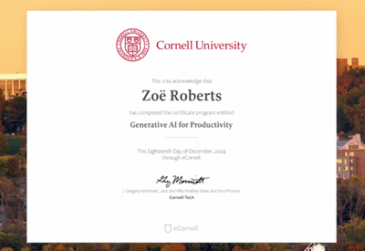
For learners who choose to share their accomplishments, eligible Cornell certificate programs now include a Cornell University Digital Credential. The secure, verified credential documents the certificate program completed along with the skills, competencies, and learning outcomes associated with the program.
Learners can share their Digital Credential on LinkedIn, résumés, professional portfolios, personal websites, and other professional channels.
But as the reflections above show, what learners choose to share often goes beyond the credential itself. Their posts tell the story behind the achievement: the work they put in, what they learned, how they’re applying it, and where they hope to go next.